
PTSD Recovery: From “I Had a Gun in My Head” to “I’m the Dad”
An Air Force veteran’s account of what five days of oxygen training unlocked — and why his daughter can finally ask him for help.
Before you read on
This page describes suicide, a gun, and PTSD. If that is hard for you today, it is fine to stop here.
If you are a veteran in crisis, help is free right now. Call or text 988, then press 1 for the Veterans Crisis Line. You can also text 838255. It is open 24 hours a day.

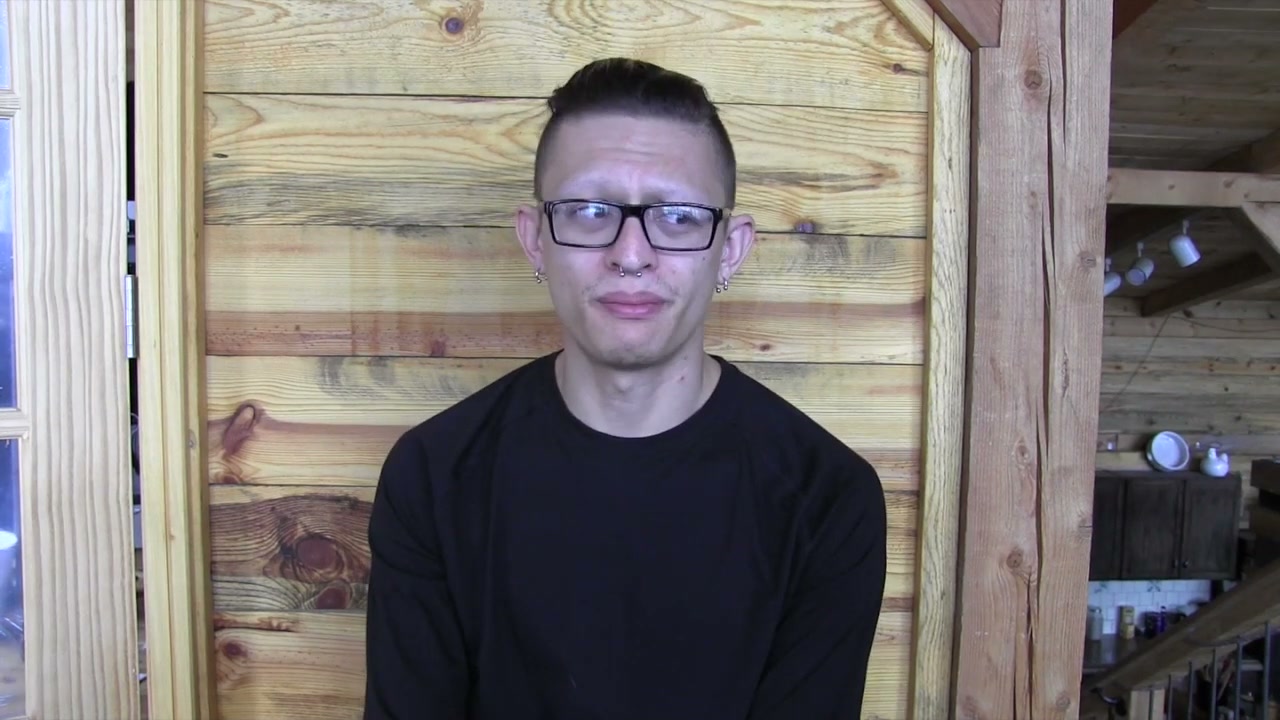
Tri Lipton’s recovery story in his own words — and his family’s.
Watch the full 53-minute interview →
▶View transcript summary
0:00 — Tri describes receiving a PTSD diagnosis, and where his life had already gone by then: manic episodes, and an attempt on his own life.
0:55 — He reads back the clinical language used to grade him, and talks about losing control of anger and aggression — and what that looked like at home.
1:42 — He describes a traumatic experience during deployment that began the decline, and explains why he never reported it or pursued it.
2:26 — Coming back, telling his NCO something was wrong, and not being heard.
3:09 — After the attempt on his life he is fast-tracked out of service and into VA care. He meets Mark Squibb, a relative of his wife, who invites him to Colorado.
3:53 — His condition before the trip: stage three hypertension, no energy, and in his own words turning into a zombie.
4:42 — His concussion history comes up — including being hit by a pickup truck while cycling. Then the first sessions on the bike.
5:40 — The physical response he was not expecting, and how quickly it arrived.
6:26 — The line the page quotes: a release that felt “like a cramp letting go of my head,” and sensation returning to parts of his head he had stopped feeling.
7:12 — Asked to rate it out of ten, he says ten plus, and describes being overwhelmed.
7:59 — Amanda speaks. She describes understanding what had been happening in his head, and getting her husband back.
8:44 — The first week home. He offers to put their daughter Theresa to bed — something Amanda had not seen him do.
9:28 — On being a parent again, and being able to absorb the ordinary difficulty of a child’s day.
10:16 — Amanda on what the family had lost and what it meant to get it back. Tri: “She comes and asks me for stuff. She asks my opinion. She asks me for help.”
11:04 — How simple the protocol turned out to be — his push-versus-pull door analogy.
11:48 — On effort: people with PTSD, he says, are already working exceptionally hard at staying alive.
12:34 — On saying yes to a chance to heal, after years of saying no.
13:32 — His closing message: this happens to people outside the military too, and if you are injured, your need for validation is real.
14:24 — Closing music and credits.
This is a timestamped summary of the film, not a word-for-word transcript. Tri describes his own experience in his own words in the video above.
The Wound Nobody Could See
Tri Lipton served in the US Air Force as fuels and security forces. He did his job. He kept others safe. He came home — but he didn’t come home whole.
The trauma happened in a place where he was supposed to be safe. He never reported it. He buried it. He moved from active duty to the reserves, hoping the change in pace would help. It didn’t.
Sleep fell apart. Mood fell apart. Drinking got worse. Two or three years later, Tri was in a VA psychiatric facility after a suicide attempt.
His motivation to keep living was simple: his wife and his daughter. That was it.
“Perpetual negative energy. Like a black hole. That’s what it feels like.”
— Tri Lipton, describing life with untreated PTSDFive Days in Colorado with No Expectations
Tri’s wife had a relative who’d been working with veterans. Mark Squibb reached out and offered an olive branch: “If you can make it out to my place, we’ll give something a shot.”
At that point, Tri was on a stack of medications that had turned him into what he calls “a zombie.” Stage 3 hypertension. Energy swings from nothing to uncontrollable. He drove to Colorado with zero expectations.
Over five days, he did multiple sessions per day on a stationary bike — at least 15 minutes each — with oxygen switching between high and low concentrations.
After the first few sessions, something he hadn’t expected started happening.
“I had a release. It felt like a cramp — like letting go of my head. Pins and needles in places I didn’t feel before. Some part of me has been reignited.”
— Tri Lipton, after his first sessionsWhat Day 5 Looked Like
The emotional “ping-pong” — the erratic highs and lows that had defined his days — slowed down. His emotional responses became more stable. He cried, but it wasn’t from sadness. It was understanding. The pieces fell back together.
“I felt more complete. Like a whole piece of something split apart, and the halves fell back together.”
Before Treatment
- Stage 3 hypertension
- Could not maintain anger or aggression levels
- Emotionally erratic — wide swings within hours
- VA hospitalization, long-term inpatient stays
- Suicide attempt
- Zombie state from medications
After Five Days
- Emotional swings stabilized
- Able to process memories without re-traumatization
- Speech and thought patterns clearer
- Returned home able to put daughter to bed
- “I’m still here. I did all the things. I’m still here.”
- Went on to complete full year of trade school
His Family Got Their Dad Back
The week after Tri returned home, he told his wife: “I’ll put Theresa to bed.”
She didn’t know what to do with herself. For years, bedtime had been impossible — too much noise in Tri’s head, not enough patience. His wife had been the sole parent by necessity.
In Their Own Words
“I got my husband back. It was like a miracle. I was able to get my life back, too — because I’d put myself on the back burner for both him and our daughter.”
— Tri’s wife“She comes and asks me for stuff. She asks my opinion. She asks what I think. She asks for help. She asks for advice. I’m the dad — I’m somebody she can come to, as opposed to somebody who needed to be avoided.”
— Tri LiptonWhat a Session Actually Is
People picture a clinic or a chamber. It is neither.
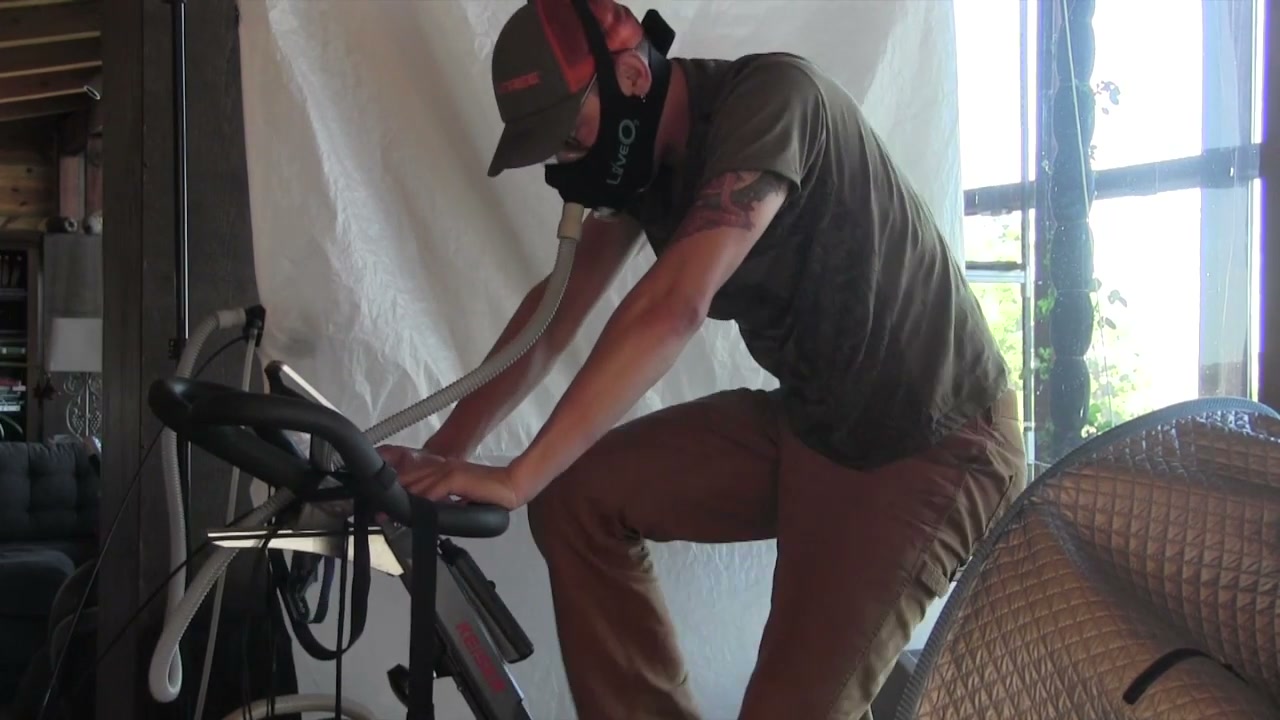
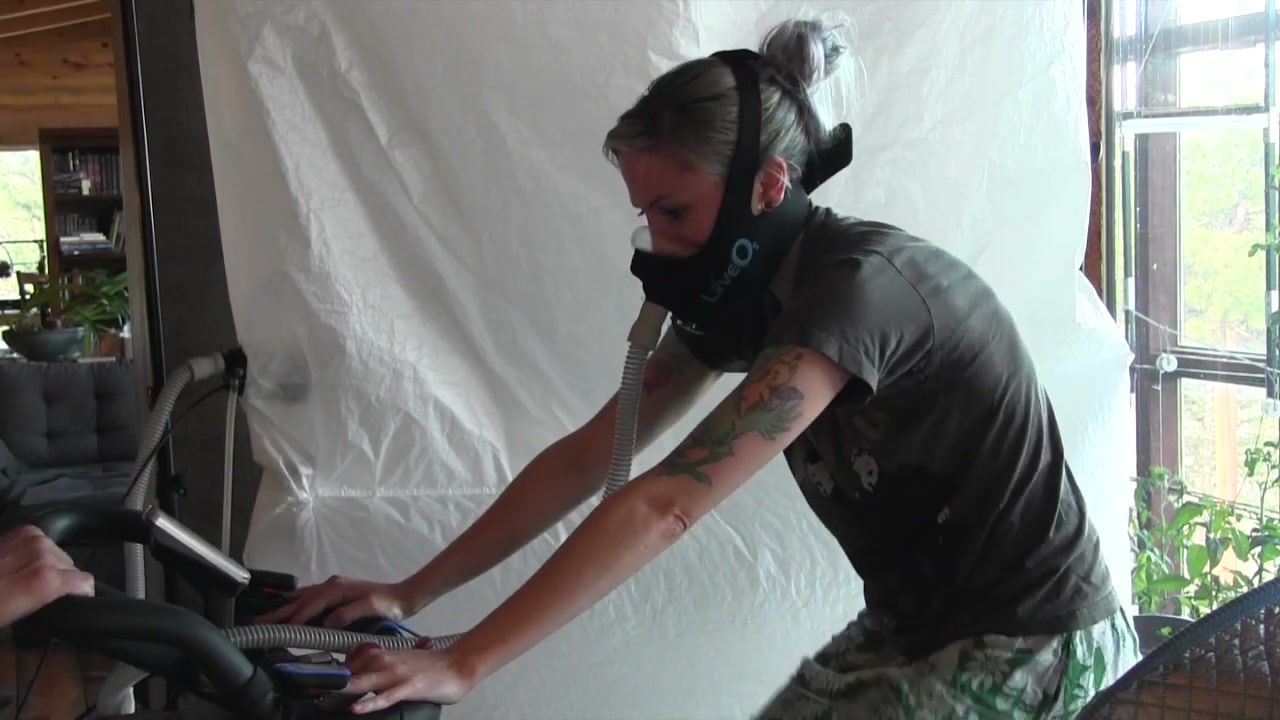
You sit on an exercise bike. You wear a mask. You pedal. A session runs about 15 minutes.
What makes it LiveO2 is what comes through the mask. The system switches between high and low oxygen while you ride — like hot-cold contrast training, but for oxygen. That switch is the patented part, and it is the whole point.
What the switch actually does
One cycle, four beats. The vessel is the same vessel throughout — what changes is how wide it is open when the oxygen arrives.
Oxygen-rich air
You breathe air with far more oxygen in it than the room.
Flip to altitude air
Oxygen falls to altitude level. Your body notices immediately.
Vessels open wide
The small vessels widen to go and get what your body is short of.
Oxygen floods through
Oxygen returns — and now it moves through a vessel already wide open.
Open the path first. Then fill it. Breathing extra oxygen while you sit still raises how much oxygen is in you, but does much less about where it goes. The switch is what opens the path — and it is the step passive oxygen treatments skip.
Why the switch matters
Breathing extra oxygen while you sit still is the weak version. It raises how much oxygen is in you. It does much less about where that oxygen goes.
Adaptive Contrast works in two steps. First you flip to altitude-level air. Your body reads the drop and opens the small blood vessels to go get what it needs. Then you flip back to oxygen-rich air, and it moves through vessels that are already wide open.
Open the path first. Then fill it. That order is the difference, and it is the step passive oxygen treatments skip.
The bike is not incidental either — it is the delivery system. Working muscles raise your heart rate, and a faster heart carries that oxygen further than it would travel at rest.
See the protocol: BrainO2.
Why This Works Without Talking About the Trauma
Years of talk therapy hadn’t unlocked what five days of oxygen training did. Tri noticed the difference.
“Kind of magical to just breathe deep and seek peace and have that be the primary vehicle for healing. Kind of hilarious how easy it was and how quickly it changed things inside my head.”
The Biology Underneath the Trauma
Talk therapy addresses the psychological layer. Oxygen training addresses the biological layer underneath it.
Trauma — especially repeated trauma — creates inflammation and restricts blood flow to the brain’s regulatory centers. Those systems go offline. They’re not destroyed. They’re just starved of what they need to function.
When oxygenated blood reaches those dormant areas, they come back online. Often quickly. Often in ways that years of medication and therapy hadn’t been able to produce.
“You don’t need to talk about whatever it is you’re going through,” Tri says. “If you can get on a bike and spin, you can do this.”
Frequently Asked Questions
LiveO2 is not a treatment for PTSD. It is not intended to diagnose, treat, cure or prevent any condition, and nothing on this page is medical advice.
Tri kept his care team. Oxygen training was something he added, not something he swapped in. If you are working with a doctor or a therapist, keep them, and tell them what you are considering.
This is one man’s account. Individual results vary. We publish it because he asked us to.
Send Tri a Message
Tri now works as a PTSD outreach lead for LiveO2. He offers his own time to veterans and families who are still deciding. If you would rather ask a person who has been where you are than read another page, write to him here.
Try It Before You Decide Anything
You do not have to drive to Colorado to find out whether this does something for you.
Find the nearest LiveO2 location, sit on a bike for 15 minutes wearing the mask, and see for yourself. That is the whole test — and it starts a conversation with someone who can answer your questions.