More Oxygen Absorption Than HBOT — In a Fraction of the Time — LiveO2
HBOT Alternative · LiveO2

More Oxygen Than HBOT — In 15 Minutes Instead of 90

Hyperbaric oxygen therapy has dominated the conversation for years. Here’s why LiveO2 Adaptive Contrast delivers superior tissue oxygenation in a fraction of the time.

Increase Oxygen Absorption in Less Time Than HBOT video

Who This Is For

This is for anyone currently using, considering, or researching hyperbaric oxygen therapy — and for health-conscious individuals who want maximum oxygenation benefit with minimal time and cost commitment.

  • People evaluating HBOT for recovery, brain health, or anti-aging
  • Existing HBOT users looking for a more time-efficient alternative
  • Biohackers optimizing their health stack for oxygen protocols
  • Athletes seeking faster recovery than HBOT’s schedule allows
  • Clinicians comparing oxygen therapy modalities for patient recommendations

The Problem with Standard Options

HBOT (hyperbaric oxygen therapy) is well-researched and effective — but it has significant practical limitations. Sessions require 60 to 90 minutes in a pressurized chamber. Clinical HBOT costs $150 to $300 per session. Home units are expensive and space-intensive. And the passive nature of HBOT — lying still in a chamber — limits the cardiovascular benefit.

For most people, HBOT’s schedule is the biggest barrier. 3–5 sessions per week at 60–90 minutes each is simply not sustainable for working professionals, athletes with training schedules, or families with competing demands. The result: people get fewer sessions than the protocol calls for, undermining the benefit.

Why LiveO2 Adaptive Contrast Wins

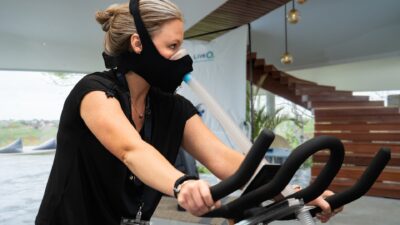
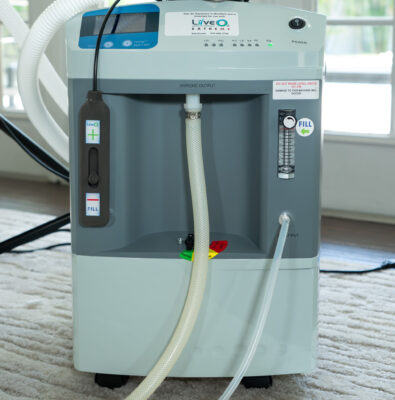
LiveO2 Adaptive Contrast achieves superior tissue oxygenation through a completely different mechanism. Rather than using pressure to force oxygen into tissues, it uses cardiovascular exercise combined with cycling oxygen-rich and oxygen-reduced air to drive oxygen into capillary beds through your body’s own pumping system — the most efficient delivery mechanism available.

15 mintypical LiveO2 session vs. 60–90 min for HBOT
↑O₂tissue saturation comparable to or exceeding HBOT
10×faster protocol completion vs. daily HBOT schedule

The active exercise component also provides cardiovascular and metabolic benefits that passive HBOT simply cannot. You’re not just delivering oxygen — you’re training your cardiovascular system to deliver it more efficiently with every session.

What Users Say After Switching

People who switch from HBOT to LiveO2 — or add LiveO2 to their protocol — consistently report:

  • Equivalent or superior tissue oxygenation outcomes with significantly shorter sessions
  • Much more sustainable weekly protocol adherence due to reduced time commitment
  • Meaningful cost savings compared to clinical HBOT or home chamber investment
  • Added cardiovascular fitness benefit not available from passive HBOT
  • Greater flexibility to fit sessions around work, family, and training schedules

Key Takeaways

  • HBOT delivers oxygen through pressure; LiveO2 uses your cardiovascular system — a more efficient and natural mechanism
  • 15-minute LiveO2 sessions replace 60–90 minute HBOT sessions for most use cases
  • Active exercise with oxygen produces cardiovascular benefits that passive HBOT cannot
  • Protocol adherence is dramatically higher with LiveO2 due to time efficiency
  • Cost per session is significantly lower with LiveO2 over a home system amortized cost
  • LiveO2 and HBOT can also be combined for specific therapeutic applications
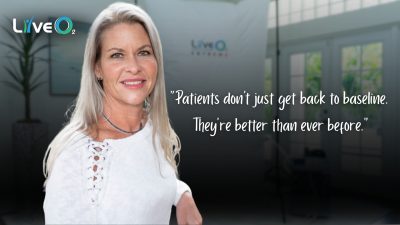
HBOT was a breakthrough in its time. Adaptive Contrast is what comes next — more oxygen, less time, better results.— Mark Squibb, Founder, LiveO2

Ready to compare for yourself?

Compare LiveO2 to HBOT for your specific health or performance goals. Our team can help you understand which protocol fits your situation.

Explore LiveO2 Systems Talk to an Expert

Frequently Asked Questions

Both systems increase tissue oxygen saturation, but through different mechanisms. HBOT uses pressure to dissolve more oxygen in blood plasma. LiveO2 uses cardiovascular exercise and oxygen contrast cycling to drive oxygen into tissues through your body’s natural circulatory system. Research and user outcomes suggest comparable or superior tissue saturation with LiveO2 in significantly less time.

LiveO2 has been used effectively for cognitive and neurological applications — including by the BrainO2 protocol specifically designed for this purpose. The oxygen delivery mechanism is different from HBOT but achieves high tissue oxygenation in the brain. Many users and clinicians report excellent cognitive outcomes with LiveO2 for the same conditions that HBOT addresses.

Home HBOT chambers range from $4,000 to $20,000+ for clinical-grade units, plus ongoing oxygen costs and maintenance. LiveO2 systems start at a significantly lower price point and have lower per-session costs. Over a typical 12-month protocol, LiveO2 produces meaningful savings versus comparable HBOT investment.

LiveO2 is used for many of the same health applications as HBOT. However, if you have a condition for which HBOT is medically prescribed, consult your prescribing physician before substituting LiveO2. For general wellness, recovery, cognitive health, and performance applications, LiveO2 is an appropriate alternative for most healthy individuals.

LiveO2 home systems are designed for self-directed use following standard protocols. They don’t require the pressurized environment of clinical HBOT and are therefore used without medical supervision by healthy adults. However, individuals with cardiovascular, pulmonary, or other health conditions should consult their physician before starting.

A typical HBOT protocol for health conditions involves 40 sessions of 60–90 minutes. LiveO2 protocols for comparable outcomes typically involve 20–30 sessions of 15–20 minutes. The time investment is dramatically lower, which also means protocol adherence is significantly higher.