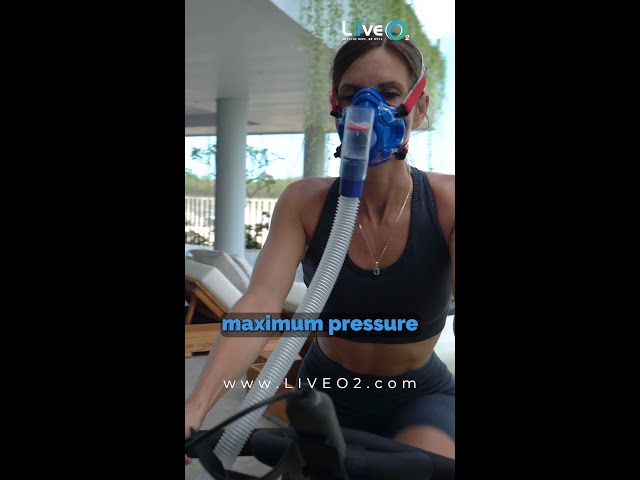
Why LiveO2 Outperforms Standard Oxygen Training — The Adaptive Contrast Advantage
More oxygen in the blood doesn’t mean more oxygen in the tissue. LiveO2 solves the delivery problem that standard oxygen training ignores.
Watch: The Adaptive Contrast Advantage
Why LiveO2 produces results that standard EWOT and passive oxygen therapy can’t match — click to play.

Who This Page Is For
You’ve used or researched standard EWOT, nasal cannula oxygen, or other oxygen training approaches and you want to understand what specifically makes LiveO2 different — and whether the difference is real or just marketing.
This is also for athletes and practitioners who have tried standard oxygen training with limited results and want to understand why the mechanism in LiveO2 produces reliably better outcomes.
What Standard Oxygen Training Gets Right — and Where It Falls Short
Standard EWOT (Exercise with Oxygen Therapy) is built on a valid insight: exercising while breathing high-concentration oxygen increases blood oxygen saturation and, over time, improves tissue oxygenation and aerobic capacity. This is real and useful. The limitation isn’t the oxygen — it’s the delivery efficiency.
At rest or during moderate exercise, most people have adequate vascular tone. Adding more oxygen to the blood helps because the vessels are reasonably open and delivery is reasonably efficient. But for clients with vascular stiffening, reduced capillary density, or impaired blood flow regulation — the populations who need oxygen therapy most — simply adding more oxygen to blood that can’t efficiently reach target tissue produces limited improvement. You need to open the vessels before the flood.
The fundamental gap: Standard EWOT optimizes the oxygen content of blood without specifically optimizing the delivery of that oxygen to tissue. Adaptive Contrast does both.
The Two-Phase Mechanism That Changes Everything
LiveO2’s Adaptive Contrast adds a single critical step that standard EWOT lacks: the hypoxic phase. By alternating between reduced-oxygen and high-oxygen breathing, LiveO2 triggers a vasodilation response during the low-oxygen phase that opens blood vessels before the oxygen delivery. This sequenced approach — dilate, then flood — achieves tissue oxygenation levels that neither phase alone nor standard EWOT can match.
The patents behind LiveO2 are built around this sequence and its effects. The dilation step isn’t incidental — it’s the mechanism that makes everything else more effective. When vessels are dilated by the hypoxic challenge, the subsequent hyperoxic phase achieves delivery into tissue beds that standard EWOT can’t consistently reach, because the vascular access to those beds has been actively opened.
What the Difference Produces in Practice
Users who have tried both standard EWOT and LiveO2 consistently report that LiveO2 sessions produce more noticeable effects — both during the session and in the hours afterward. This aligns with the mechanism: deeper tissue delivery produces stronger physiological responses.
- More pronounced in-session experience — the hyperoxic phase after vasodilation produces a distinctly noticeable clarity or warmth that standard EWOT typically doesn’t generate
- Better post-session outcomes — energy, recovery, and cognitive clarity effects that last longer and register more strongly than standard EWOT users typically report
- Results in populations where standard EWOT underdelivers — older clients, highly deconditioned individuals, and clients with vascular health issues respond to LiveO2 where standard EWOT produced limited benefit
The performance gap between LiveO2 and standard EWOT widens in exactly the populations that standard EWOT serves least well: those with the greatest delivery limitations. Adaptive Contrast specifically addresses the limitation that holds those populations back.
“EWOT is a step forward from breathing room air. Adaptive Contrast is two steps forward from EWOT. The hypoxic dilation phase is the difference — and it’s not a small one.”
— Mark Squibb, CEO & Inventor of LiveO2Key Takeaways
- Standard EWOT improves blood oxygen content but doesn’t specifically address vascular delivery limitations — which limits its effectiveness in the populations that need oxygen therapy most
- Adaptive Contrast adds the hypoxic dilation phase that opens blood vessels before oxygen delivery, achieving tissue oxygenation that standard EWOT can’t match
- The sequence matters: dilate first, then flood. Reversing or omitting the dilation step produces fundamentally less effective delivery
- Users with prior EWOT experience consistently report more pronounced and durable effects from LiveO2 sessions
- The gap between LiveO2 and standard EWOT is largest in clients with the greatest delivery limitations — older clients, deconditioned individuals, vascular health issues
- LiveO2 compresses what standard EWOT achieves in 30–60 minutes into a 15-minute session, because the mechanism is more efficient
“Standard EWOT gives you more oxygen in blood that still can’t get where it needs to go. Adaptive Contrast opens the door first. That’s the difference.”
— Mark Squibb, CEO & Inventor of LiveO2Questions About LiveO2 vs. Standard Oxygen Training
Standard EWOT equipment cannot be converted to Adaptive Contrast — the hypoxic delivery mechanism requires the LiveO2 system’s engineered oxygen switching capability, which is patented technology. If you have an existing EWOT setup, LiveO2 can advise on how to transition. Call 970-658-2789 to discuss your current equipment and options.
Standard EWOT does produce real benefits — particularly for younger, healthy users with reasonably functional vascular delivery. For these users, the limitation of not having the dilation step is smaller because their vessels are already reasonably open. The difference becomes more pronounced for users with vascular health issues, age-related vascular stiffening, or significant baseline delivery deficits. Standard EWOT is helpful; Adaptive Contrast is more helpful, particularly for the populations with greatest need.
Nasal cannula oxygen at rest increases blood oxygen content but produces no vasodilation stimulus and no exercise-driven blood flow enhancement. It’s the baseline of oxygen supplementation. LiveO2 adds exercise (increasing cardiac output and blood flow), Adaptive Contrast vasodilation, and high-concentration oxygen delivery — making it comprehensively more effective at tissue oxygenation. Nasal oxygen at rest and LiveO2 are not comparable interventions.
Yes. The Adaptive Contrast mechanism — the specific sequencing and delivery of hypoxic and hyperoxic breathing during exercise to achieve enhanced tissue oxygenation — is covered by LiveO2’s patents. This is why standard EWOT systems don’t include this capability: it requires both the engineering and the intellectual property that LiveO2 holds.
Yes — there’s no contraindication to using standard EWOT alongside LiveO2. If you have both systems, using them on different days produces different but complementary benefits. That said, most users who have experienced Adaptive Contrast find standard EWOT noticeably less effective in comparison and shift entirely to LiveO2.
Head-to-head comparative research is limited. The mechanism comparison is well-supported by the underlying exercise physiology literature on hypoxic preconditioning and vascular response. LiveO2-specific research is ongoing. The most compelling evidence is experiential: users who have done both consistently describe Adaptive Contrast as producing more pronounced and durable effects. Call 970-658-2789 to discuss the evidence base in more detail.