
Mark Squibb Explains BrainO2 — How Adaptive Contrast Restores Brain Oxygen
The inventor of LiveO2 breaks down the mechanism behind BrainO2: why the brain loses oxygen, and how Adaptive Contrast gets it back.
Watch: Mark Squibb on BrainO2
Mark explains the Adaptive Contrast mechanism for brain oxygenation in his own words — click to play.
Who This Page Is For
You want to understand the science behind BrainO2 from the person who built it — not marketing language, but the actual mechanism. You’re either evaluating LiveO2 for a specific cognitive concern or you want to go deeper on how Adaptive Contrast produces its brain-specific effects.
This is also useful for practitioners who want to explain the BrainO2 mechanism to clients in concrete, physiological terms.
Why the Brain Is Uniquely Vulnerable to Oxygen Deficits
Mark Squibb built BrainO2 after recognizing a pattern in LiveO2 users: cognitive improvements were consistently among the most reported and most striking outcomes across his entire user base. The brain was responding to oxygen in ways that general wellness applications weren’t fully capitalizing on. The reason, as he explains, is straightforward: the brain has no oxygen reserve. Every second it runs on current delivery.
When cerebrovascular efficiency drops — as it does with age, stress, inactivity, or inflammation — the brain can’t buffer the shortfall. It just runs slower. And because the decline is gradual, most people normalize it: “I’m just tired,” “I can’t focus like I used to,” “it’s just getting older.” What they’re experiencing, Mark explains, is a delivery problem — and delivery problems have delivery solutions.
Mark’s core insight: Standard oxygen therapy delivers more oxygen. Adaptive Contrast makes sure it actually reaches the tissue that needs it. That distinction is everything.
How Adaptive Contrast Reaches the Brain
Standard EWOT — breathing high-oxygen air during exercise — increases blood oxygen saturation. But oxygen saturation and tissue oxygenation are different things. If the vessels supplying brain tissue are constricted or inefficient, high saturation doesn’t translate to delivery. The oxygen stays in the bloodstream; the brain stays underfueled.
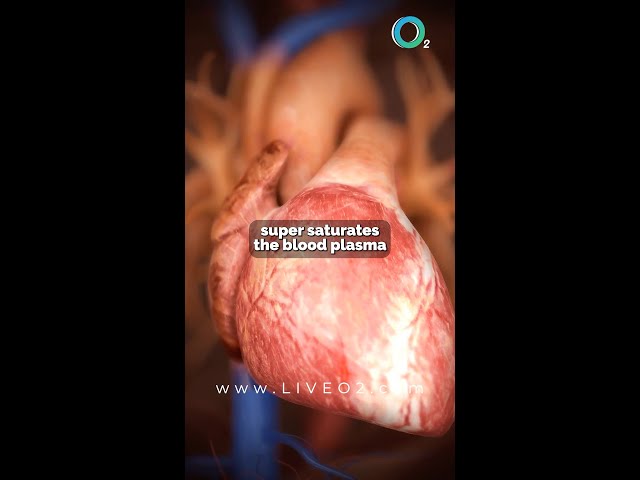
Adaptive Contrast solves this with a two-phase mechanism. The hypoxic phase — reduced-oxygen air — signals the cerebrovascular system to dilate. It’s a physiological emergency response: vessels open to compensate for the perceived oxygen shortage. Then, at peak dilation, the system switches to hyperoxic air. The open vessels are immediately flooded with oxygen-rich plasma at a delivery pressure that passive breathing can’t generate. The brain receives more oxygen than it has at any point in years.
What Mark Has Observed Across BrainO2 Users
After years of LiveO2 deployments, Mark describes cognitive outcomes as among the most consistent and most emotionally significant results he encounters. Clients who couldn’t articulate exactly what was wrong often describe their post-BrainO2 experience with striking clarity: “I feel like myself again.”
- Clarity that clients describe as immediate — a sense during or immediately after the hyperoxic phase that something has shifted; most describe it as the fog lifting
- Sustained daily improvements that accumulate over sessions: better focus at work, faster recall, less mental fatigue by afternoon
- Emotional lift alongside cognitive improvement — because the same oxygen deficit that suppresses cognitive function also affects mood regulation and emotional resilience
The consistency of these outcomes across very different client profiles — from athletes to seniors to post-viral recovery patients — is what convinced Mark to formalize BrainO2 as a dedicated protocol rather than a general application of the LiveO2 system.
“When people tell me they feel 15 years younger after a session, they’re not exaggerating. They’re describing what happens when a brain that’s been running on a deficit finally gets what it needs.”
— Mark Squibb, CEO & Inventor of LiveO2Key Takeaways
- The brain has no oxygen reserve — it depends entirely on real-time delivery, making it acutely vulnerable to any decline in cerebrovascular efficiency
- Adaptive Contrast achieves cerebral oxygenation through a two-phase mechanism: hypoxic dilation followed by hyperoxic flooding
- Standard EWOT increases blood oxygen saturation but doesn’t guarantee tissue delivery — Adaptive Contrast addresses the delivery gap
- BrainO2 was formalized as a dedicated protocol because Mark observed consistent cognitive outcomes across all client demographics
- Many clients describe the cognitive effect as immediate — clarity felt during or right after the hyperoxic phase
- Emotional and cognitive improvements often appear together, because both depend on the same oxygen delivery system
“Oxygen is the one intervention that affects everything simultaneously. Get it to the brain consistently and the results speak for themselves.”
— Mark Squibb, CEO & Inventor of LiveO2Questions About the BrainO2 Mechanism
The hypoxic phase triggers cerebrovascular dilation — a physiological emergency response that opens blood vessels to compensate for perceived oxygen shortage. This dilation is what allows the subsequent hyperoxic phase to deliver oxygen deeply into brain tissue. Without the dilation step, high-oxygen air enters already-constricted vessels and tissue delivery is limited. The sequence is the mechanism.
Yes. The hypoxic phase replicates the oxygen levels experienced at moderate altitude — conditions that millions of people live in permanently without harm. It produces mild breathlessness, which is normal and brief. The system switches to hyperoxic air before any meaningful physiological stress occurs. LiveO2 systems include safety features that ensure the switch happens on the correct timed cycle. See: LiveO2 safety and testing.
High-altitude training uses sustained low-oxygen exposure to stimulate adaptations over weeks. BrainO2 uses brief, repeated hypoxic pulses followed immediately by hyperoxic flooding — in a single 15-minute session. The goal isn’t adaptation to low oxygen; it’s using the dilation response as a delivery mechanism for high oxygen. The outcome is acute cerebral oxygenation, not long-term altitude adaptation.
Deep breathing increases oxygen saturation in the blood but doesn’t dilate cerebrovascular pathways. If those pathways are constricted or narrowed — which is common with age and inactivity — more oxygen in the blood doesn’t translate to more oxygen in brain tissue. You need the vessels to open first. That’s what the hypoxic phase accomplishes; deep breathing cannot.
The brain responds to oxygen availability immediately — because oxygen is what its mitochondria are burning right now, not stored fuel. Many BrainO2 clients notice clarity or energy shifts during or within minutes of a session. The cumulative effect of repeated sessions is greater: baseline cerebrovascular health improves, so the benefit of each session compounds.
The mechanism is consistent across users because cerebral oxygenation is a universal physiological process. That said, the magnitude of response varies with baseline deficit: clients with significant oxygen delivery impairment tend to see the most dramatic early results, while clients with healthy baselines see optimization-level improvements rather than recovery-level ones. Most users see meaningful results; the experience varies in degree, not direction.