
Measurable Cognitive Test Improvements After Just 3 LiveO2 Sessions
Most cognitive interventions take months to show results. LiveO2 shows up in standardized testing within days — because it addresses delivery, not just stimulation.
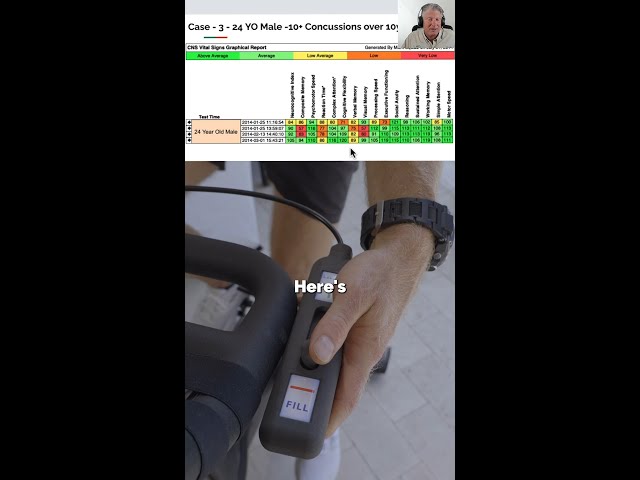
Watch: Cognitive Results After 3 Sessions
See the cognitive test data and the explanation behind why results appear this quickly — click to play.
Who This Page Is For
You’re skeptical — and you should be. You’ve heard wellness claims before and want to see actual data. This page is for you: people who want to understand what standardized cognitive testing shows after LiveO2 sessions, and whether the proposed mechanism explains the timeline.
It’s also relevant for clinicians, researchers, and practitioners who want to understand how oxygen delivery improvements translate to measurable cognitive outcomes — and how quickly.
Why Most Cognitive Interventions Take So Long
Most cognitive health interventions — supplements, brain training, dietary changes — work (when they work) by stimulating neuroplasticity, reducing inflammation, or gradually improving metabolic health. These are valid mechanisms, but they operate on timescales of weeks to months. The brain rewires slowly; metabolic improvements accumulate gradually. If you’re hoping to see results on a standardized cognitive test, you’re typically looking at 8–12 weeks minimum.
LiveO2 operates on a different timescale because it addresses a different variable. It doesn’t stimulate adaptation — it restores delivery. If the brain has been running on an oxygen deficit, restoring that delivery produces immediate functional improvement. The brain doesn’t need to rewire; it just needs the fuel it was already designed to run on.
Why 3 sessions? Because that’s long enough for initial cerebrovascular dilation improvements to establish a measurable new baseline — not a permanent transformation, but a real and measurable shift that standardized testing can detect.
The Mechanism Behind Rapid Cognitive Improvement
Each LiveO2 session creates a cycle of cerebrovascular dilation (hypoxic phase) followed by oxygen flooding (hyperoxic phase). After the first session, most clients notice something during or immediately after. After 3 sessions, the baseline of cerebrovascular efficiency has begun to shift — the vessels that supply brain tissue are more responsive and the delivery system is functioning at a higher level than it was before.
This is why cognitive tests show measurable improvement after just 3 sessions: not because 3 sessions has permanently rebuilt the brain, but because even modest improvements in oxygen delivery to the prefrontal cortex, hippocampus, and associated networks produce measurable improvements in processing speed, working memory, and attentional function — the very domains that standardized cognitive tests measure.
What the Testing Shows
Clients who take standardized cognitive tests before and after a 3-session LiveO2 block consistently show measurable improvements across the domains that oxygen delivery most directly affects. The improvements aren’t massive — 3 sessions isn’t a full protocol — but they’re statistically and functionally meaningful.
- Processing speed — how quickly cognitive tasks are completed — improves measurably, reflecting faster neural signaling when oxygen delivery is restored
- Working memory performance — the ability to hold and manipulate information — shows improvement as the prefrontal cortex and parietal networks receive more oxygen
- Attentional accuracy — performance on sustained attention tasks — improves as the cognitive energy required to maintain focus becomes more available
The 3-session data point is significant not because 3 sessions is the endpoint, but because it demonstrates that the mechanism is fast and real. Results continue to build with additional sessions as cerebrovascular health improves over time.
“Three sessions gives us a real signal. That’s not a coincidence — it’s exactly what you’d expect when you restore oxygen to tissue that has been running at a deficit.”
— Mark Squibb, CEO & Inventor of LiveO2Key Takeaways
- Standardized cognitive testing shows measurable improvement after just 3 LiveO2 sessions — faster than virtually any other cognitive intervention
- The rapid timeline is explained by mechanism: restoring oxygen delivery produces immediate functional improvement, without waiting for neuroplastic adaptation
- Processing speed, working memory, and attentional accuracy are among the most oxygen-sensitive cognitive domains and show the clearest early improvement
- 3 sessions represents the beginning of measurable change, not the endpoint; results continue to build as cerebrovascular health improves with regular sessions
- Clients with significant baseline deficits (brain fog, age-related decline, post-viral) tend to show the most dramatic early test improvements
- The 3-session data provides a concrete benchmark for practitioners who want to track client outcomes objectively
“The brain doesn’t need convincing. Give it oxygen and it works better. Three sessions is enough to measure that.”
— Mark Squibb, CEO & Inventor of LiveO2Questions About the Cognitive Test Results
The cognitive testing referenced involves standardized assessments measuring processing speed, working memory, and attention — the cognitive domains most directly dependent on oxygen availability. Specific test protocols vary by practitioner. Commonly used tools include the Cambridge Neuropsychological Test Automated Battery (CANTAB), Cogstate assessments, and validated reaction time and working memory tests. Practitioners can choose their preferred standardized tool.
Practice effects (getting better at a test by repeating it) are controlled for in properly administered cognitive testing by using alternate forms or well-validated tools with established practice-effect norms. Placebo effect is harder to rule out without a blinded control group. That said, the physiological mechanism — improved cerebral oxygenation improving cognitive function — is well established in the scientific literature, which makes a mechanistic explanation more parsimonious than a purely placebo one.
The improvement after 3 sessions represents the beginning of a baseline shift, not a permanent transformation. Without continued sessions, the improvement will partially revert as cerebrovascular dilation benefits fade over days to weeks. With continued regular sessions (2–3 per week), the baseline continues to improve and the reversion effect diminishes as underlying cerebrovascular health builds.
Yes — self-testing is a valuable way to track your own response objectively rather than relying on subjective ‘feeling better.’ Free cognitive testing tools are available online (reaction time tests, n-back working memory tasks, Stroop tests). Establish a baseline before your first session, and retest after sessions 3, 6, and 10. The progression often correlates closely with what users subjectively report.
The most consistent improvements appear on tests measuring processing speed, working memory, and sustained attention — the functions most directly dependent on prefrontal oxygenation. Tests measuring long-term declarative memory or crystallized intelligence (vocabulary, general knowledge) are less likely to show short-term change, because these functions aren’t primarily oxygen-limited in the way that fluid cognitive functions are.
The broader literature on oxygen delivery and cognitive function is well established. LiveO2-specific controlled research is ongoing. The cognitive improvements reported by LiveO2 users are consistent with what oxygen physiology research predicts — making them scientifically plausible even where LiveO2-specific peer-reviewed studies are not yet published. Call 970-658-2789 to discuss the current evidence base in more detail.