
The Flu and Oxygen: Why Your Immune System Stalls — and How to Fix It
Mark Squibb’s whole family was flat for 3–4 weeks. He had a flight in 4 days. He used LiveO2 and got on that plane. Here’s the science of what actually happens to your lungs during the flu.
Why the Flu Hits Hard — The Real Mechanism
The flu isn’t just a virus. It’s a respiratory collapse that shuts down the very system your body needs to fight back.
Here’s the sequence Mark explains:
How Oxygen Breaks the Cycle
LiveO2 delivers oxygen at 75%+ concentration — well above normal air (21%). This pushes oxygen directly through the mucus barrier and into the bloodstream via plasma saturation.
When the immune system gets that oxygen, it can run at full capacity again. Fever management, viral clearance, and tissue repair all accelerate. The result is a dramatically shorter recovery window.
“My entire family was down for 3–4 weeks. My three boys, my wife — they couldn’t get off the couch. I had to be on a plane in 4 days. So I went into a panic. I got on the program. And I got on that plane.”
— Mark Squibb, LiveO2 CEO and founderMark also had a second bout after returning from his trip. He cleared that in 3 days using the same approach.
Robert Parsons, LiveO2’s director of sales, had a similar experience. His wife also used it. The consistent pattern: shorter duration, less severity, faster return to normal.
Using LiveO2 When You’re Sick
Important: Adjust Your Protocol When Ill
When you’re actively sick, don’t train at full intensity. Your goal is oxygen delivery, not cardiovascular stress. Reduce exercise intensity. Use low-resistance movement — just enough to increase circulation and move oxygen through the body. Let the system do the work.
The goal is to get oxygen into the bloodstream faster than your compromised lungs can on their own. Even gentle exercise — walking pace on a bike, slow pedaling — dramatically increases circulation and oxygen delivery compared to lying still.
Tom Butler also recommends the Respiratory Recovery protocol, which combines LiveO2 sessions with immune-support strategies for faster clearance. A link to that protocol is available at rr.liveo2.com.
Research on oxygen therapy and immune function supports this approach: studies show that immune cell activity — including neutrophil and lymphocyte function — is oxygen-dependent and declines significantly under hypoxic conditions.
Common Questions
Yes, with modifications. The key is to reduce exercise intensity. You’re not training — you’re delivering oxygen. Light pedaling or slow movement is enough to increase circulation. Hard sprints when sick would be counterproductive. Consult your healthcare provider if you have concerns about exercising while ill.
When your immune system attacks infected lung cells, it creates mucus that blocks oxygen transfer. Your blood oxygen drops to roughly 50% of normal. Every cell in your body — including the ones trying to fight the virus — runs on oxygen. At 50% oxygen, you have 50% energy. That’s why you can’t get off the couch.
Immune cells — white blood cells, neutrophils, lymphocytes — need ATP to function. ATP is made through aerobic metabolism, which requires oxygen. When oxygen is limited, immune cell activity drops significantly. Restoring oxygen availability lets the immune system run at full capacity, dramatically accelerating recovery.
Regular LiveO2 training may support immune resilience by keeping oxygen delivery systems healthy and reducing chronic inflammation. Tom Butler reported avoiding colds and flu during his 11-week VO2 Max test. However, LiveO2 is not a treatment for any specific disease. Consistent training builds a baseline that may help your immune system respond faster when challenged.
Mark’s family members who didn’t use LiveO2 were sick 3–4 weeks. Mark recovered in 4 days. His second bout cleared in 3 days. This is anecdotal, but the mechanism makes sense: more oxygen = more immune energy = faster clearance. Individual results will vary based on health status, viral load, and how quickly you start using the protocol.
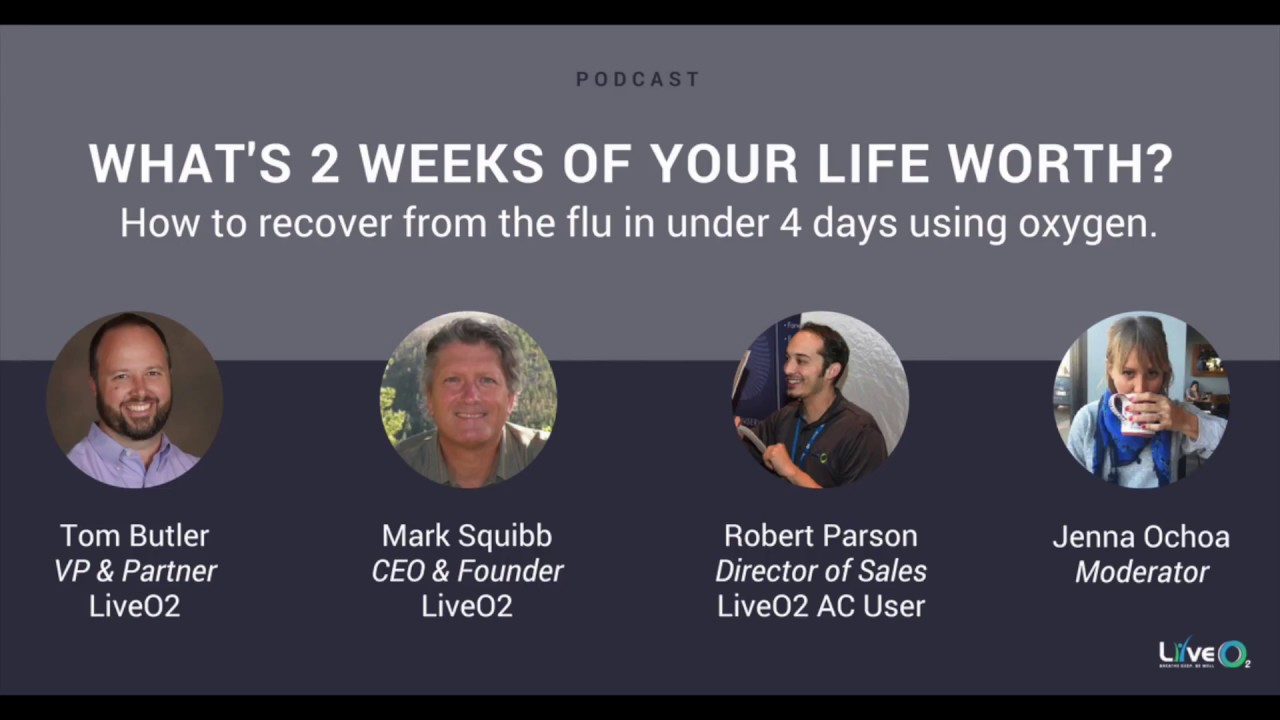
The episode featured Mark Squibb (CEO and founder of LiveO2), Tom Butler (VP and Partner), and Robert Parsons (Director of Sales and LiveO2 trainer). Robert shared his personal experience using the protocol on himself and his wife. All three discussed the science and practical application of oxygen training during respiratory illness.