
LiveO2 Quick Intro
What happens when you change what you breathe while you exercise? A 15-minute session. Real results. Here’s the short version.
Watch the Full Introduction
LiveO2 CEO Mark Squibb and real users explain what oxygen training does and why it works.
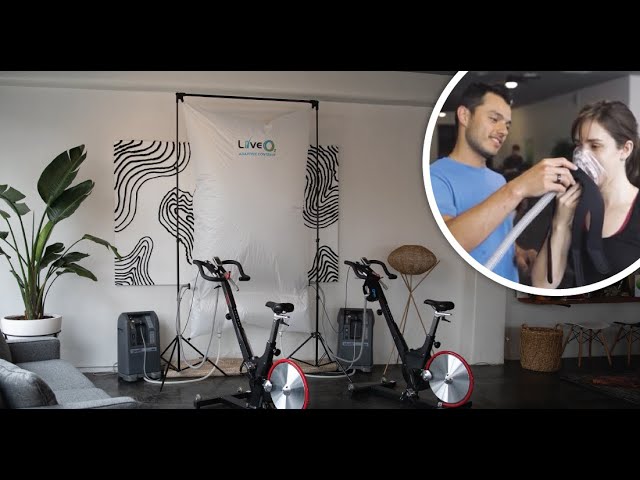
This short overview covers everything: what Adaptive Contrast is, why it works, and what real users experience after their first session. Featured on Worldwide Business with Kathy Ireland.
Why People Choose LiveO2
Life is hard. Before LiveO2, your options for better oxygen delivery were limited. Exercise harder. Or move to a mountaintop.
Neither one is easy. Neither one is fast.
LiveO2 changes the equation. It changes what you breathe while you exercise. That means you get more of the respiratory effect — in less time, with less effort, and with results you can actually feel.
“What we do is we change what you breathe while you exercise so that you get more of the respiratory effect.”
— Mark Squibb, CEO & Inventor of LiveO2That’s it. That’s the core idea. You exercise. LiveO2 handles the oxygen. Your body does the rest.
The Secret: Adaptive Contrast
Here’s the part most people miss.
LiveO2 doesn’t just give you more oxygen. It uses a technique called Adaptive Contrast. You switch between oxygen-rich air and oxygen-reduced air while exercising.
When you breathe reduced oxygen, your blood vessels open up. Your heart rate climbs. Your body goes into “hunt mode” — searching for every molecule of oxygen it can find.
Then you switch back to high-oxygen air. And your wide-open blood vessels flood with oxygen-saturated plasma.
Respiratory turbulence works like bubbles in a fish tank. Fast-moving, oxygen-rich air transfers oxygen into your body’s water. That water carries it everywhere — including places normal breathing can’t reach.
The result? Up to 6x more dissolved oxygen in your plasma compared to breathing oxygen through a mask alone. In about 15 minutes. Research on oxygen-enhanced exercise has shown measurable improvements in tissue oxygenation and exercise tolerance (PubMed: 17482363).
A Game Changer for Practitioners
Doctors and clinicians noticed something early. LiveO2 wasn’t just helping athletes. It was helping people who had tried everything else.
“I have been working with LiveO2 for over five years now. This was an absolute game changer for my practice. We started getting results — especially people with brain trauma, fatigue, deconditioning, and pain.”
— Physician featured in LiveO2 Quick IntroThe key word is immediate. Not “come back in six months and we’ll see.” Patients were feeling different after one session. Inflammation dropping. Energy returning. Brain fog clearing.
And all they were adding was oxygen and exercise.
That’s what makes LiveO2 different from most interventions. It’s not a drug. It’s not a supplement. It’s the most fundamental input your cells need — delivered more effectively than your body can do on its own.
What Users Feel After Their First Session
Everyone describes it a little differently. But the themes are the same.
Energy. Not jittery, caffeine energy. The kind where you feel wide awake and grounded at the same time. One user in the video put it simply: “I had so much more energy. I felt lighter and better. It was awesome.”
Clarity. Brain fog lifts. Thinking sharpens. People describe it as if someone turned the lights on inside their head.
Recovery. Athletes report almost no soreness. Faster recovery between sessions. More output with less fatigue.
Inflammation. Practitioners report immediate reductions in inflammation markers. That’s not surprising — oxygen is one of the body’s primary anti-inflammatory tools. A 2016 review confirmed that enhanced oxygen delivery modulates inflammatory pathways in injured tissue (PubMed: 27388542).
“We will just work on the internal terrain of the body and set the stage for the body to heal itself. A big component of that is oxygen.”
— Physician featured in LiveO2 Quick IntroWho Is LiveO2 For?
Short answer: anyone with a body.
Long answer: LiveO2 was built for people who want results without spending their entire day in a gym. A session takes about 15 minutes. You ride a stationary bike or walk on a treadmill. The system handles the rest.
For athletes: Same training produces more performance, in less time, with less fatigue and near-instant recovery.
For practitioners: A way to deliver oxygen-driven results to patients without expensive equipment or lengthy sessions.
For everyday people: A shortcut to the kind of energy and clarity that normally takes months of lifestyle changes to achieve.
LiveO2 is the original patented oxygen system. Made in the USA. Designed to amplify exercise so that a short workout produces outsized health results.
Common Questions
LiveO2 is an oxygen training system that changes what you breathe while you exercise. It uses Adaptive Contrast — switching between oxygen-rich and oxygen-reduced air — to dramatically increase oxygen delivery to your cells in about 15 minutes.
About 15 minutes. You exercise on a bike or treadmill while the system manages the oxygen and altitude contrast automatically. Most people feel the effects within their first session.
Adaptive Contrast is LiveO2’s core technology. It switches between high-oxygen and low-oxygen air during exercise. The low-oxygen phase opens your blood vessels. The high-oxygen phase floods them with saturated plasma. The result is dramatically more oxygen reaching your tissues. Full explanation here.
LiveO2 uses the same oxygen you breathe every day — just in higher concentrations, combined with controlled exercise. It is a non-invasive training system. As always, consult your healthcare provider if you have specific medical concerns.
Athletes, practitioners, biohackers, and everyday people. LiveO2 systems are used in clinics, gyms, training facilities, and homes across the country. See how one doctor discovered it.