
Grayson and the Big C
A Recovery Story
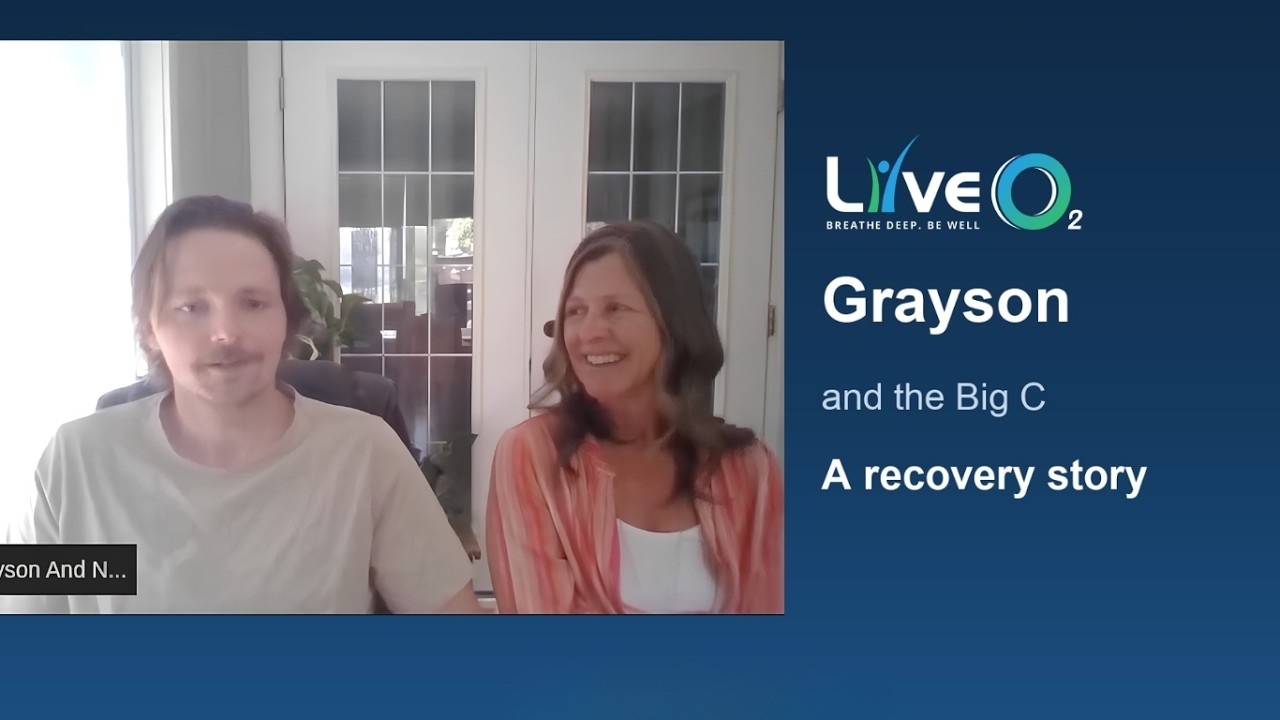
Grayson and Nicole tell the story in their own words.
Log in to the LiveO2 app to see Grayson’s full, uncensored story.
See the full story →Grayson’s Account
I noticed a lump on my right testicle about three or four months before anything happened. It didn’t cause much pain, so I didn’t think much of it — until one day it did.
I went to the emergency room. I was there about ten hours waiting on a radiologist to read the ultrasound. The staff mentioned they didn’t think it was going to be good news. Then the radiologist called me in and told me it was more than likely testicular cancer, and that I needed surgery right away.
“We’ll have to book you in for surgery right away.”— what Grayson was told at the hospital
I had the surgery. I thought I was in the clear until the day after my birthday, May 4th. I couldn’t even stand up straight — easily the worst pain I’d ever been in. What they found was that the cancer had spread to my lymph nodes. When that happens, the lymph nodes swell up trying to fight it. One had wrapped around my ureter and was squeezing it. That’s what I was feeling.
My doctors told me that with an aggressive type like this — embryonal carcinoma — I was looking at maybe six months to a year without treatment, and they wanted to start chemo right away. I got as far as the chair.
“I was in the room with an IV already in my arm. But the more they told us about the side effects, the more scared all of us got, until finally I said I wasn’t going to do it. I had them take the needle out, and I walked out of the hospital. I cried the whole ride home and didn’t understand why, until about a week later — I felt like I’d just dodged a major bullet.”— Grayson, on walking out before chemotherapy
Instead, I went all in on a different path: LiveO2 oxygen training twice a day — the Whole Body Flush protocol in the morning, and Blood Cell Bootcamp in the evening — plus big diet changes, supplements, detox baths, and Pulse Press. My oncologist agreed to monitor me closely, week by week, with frequent scans.
The pain was the first thing to change — and fast. I’d been on morphine in the hospital, the worst pain of my life; within days of starting, I was off it.
“In the hospital your pain is 10 out of 10. Right now, after four sessions, where would you rate it?” — “0.5 out of 10.”— Nicole asking Grayson, and his answer
I kept training every day — and the changes went well beyond the scans. I’m down about 35 pounds. My resting heart rate has dropped from the high 80s into the mid-40s. My lung capacity is noticeably better, and my energy is through the roof.
Grayson’s LiveO2 Protocol
Grayson didn’t do this halfway — he made his health a full-time job. His daily routine:
- LiveO2, every day. The Whole Body Flush protocol (also known as Whole Body O2) in the morning, and Blood Cell Bootcamp in the evening — starting with four sessions in his very first weekend.
- Pulse Press. Pairing the oxygen training with a low-glucose, ketogenic-style diet — the approach he and Nicole called “Pulse Press.”
- Everything else. Clean water, targeted supplements, detox and foot baths, air purifiers — “kind of everything you can think of,” in his words.
“He was all in. He didn’t waver on anything — he just did it, with a great attitude the whole time. His mindset would blow your mind.”— Nicole
The Journey
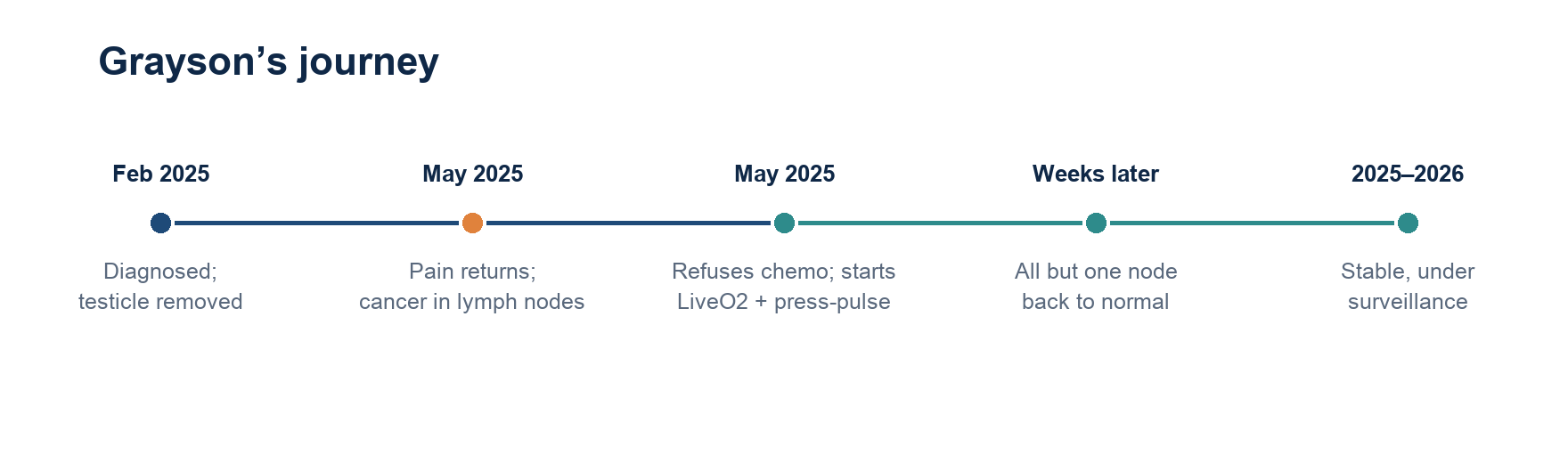
See the detailed timeline ›
- Feb 18, 2025 — An ER visit for groin pain led to an ultrasound and the initial diagnosis.
- Feb 21, 2025 — Orchiectomy; pathology confirmed embryonal carcinoma. He was told to expect roughly a year without aggressive treatment.
- May 6, 2025 — Chemotherapy was declined before the line was administered.
- May 4, 2025 onward — Daily training began: the Whole Body Flush protocol in the morning, Blood Cell Bootcamp in the evening, alongside diet changes and Pulse Press.
- May 14, 2025 — A CT scan measured the tumors and lymph nodes smaller than the May 4 baseline.
- Jun 18, 2025 — A CT scan noted a significant reduction in volume.
- Aug 11 & 27, 2025 — A CT scan and biopsy raised a question about what the changes meant — active growth, or a different process such as tissue breakdown related to an immune response. Only continued imaging could settle it.
- Oct 15, 2025 — A CT scan measured larger than the original pre-treatment baseline, but smaller than the scan immediately before it.
- Oct 2025 — Grayson and his partner were married.
- Jan 22 & Apr 23, 2026 — CT scans documented continued structural stability, with no new lymph node involvement.
- Grayson and his wife have since begun growing their family.
Dates and findings drawn from Grayson’s imaging reports, confirmed by Grayson and Nicole.
What the Scans Show
Grayson’s cancer was confirmed by biopsy — there was never a question that it was real, or that it was aggressive. Since he declined chemotherapy and began LiveO2, his imaging tells a clear story: the disease stopped advancing. Over the months that followed, all but one of the affected lymph nodes returned to normal size. The one that remained — the node a biopsy had confirmed was cancer — stopped growing and began breaking down from the inside — going necrotic, meaning the tumor tissue inside it was dying off. It has stayed stable since, and Grayson remains under active medical surveillance.
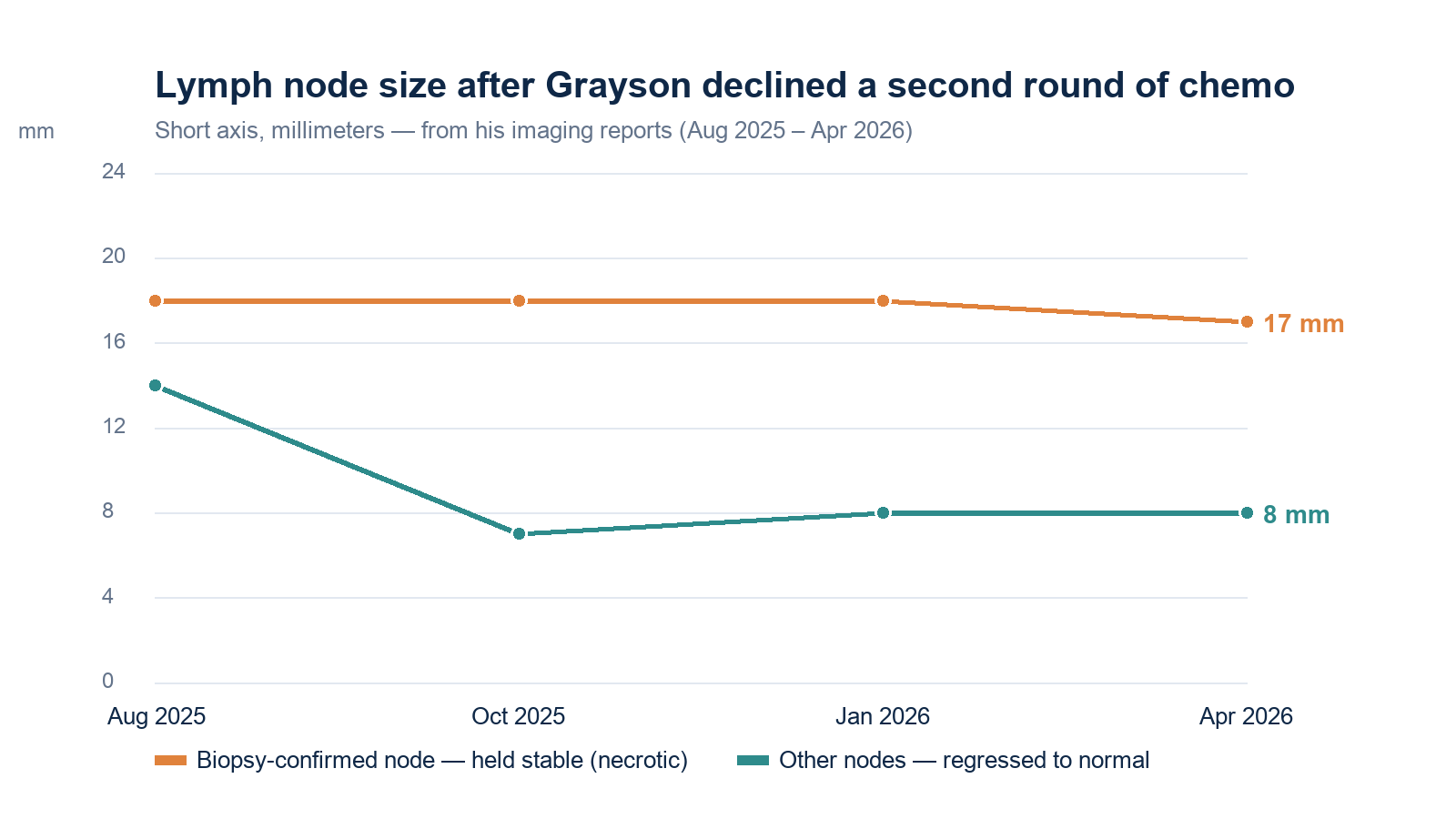
An aggressive, biopsy-proven cancer has not advanced in more than eight months — on a path he chose himself. His oncologist continues to monitor one node that still shows changes; only imaging over time will confirm whether it holds active disease.
Under His Doctor’s Watch
Grayson didn’t walk away from medicine — he chose a different path within it. Throughout, he stayed under the care of his oncologist, who agreed to monitor him closely and ordered the frequent CT and MRI scans this account is drawn from. He continues to be followed with regular imaging today.
Nicole’s Account
I was there for the sessions. I wasn’t at his scans or his appointments with the oncologist — his fiancée, now his wife, and his mom were there for those, and they kept me updated after each one. What stood out to me was how fast things moved once he started training — and how the doctors reacted to it.
“Not only did he get rid of it — then we go back and the doctors don’t believe it. Now they’re backtracking, trying to say he never had cancer, or questioning whether he ever had it. But they were still willing to hook him up to chemo, which is shocking.”— Nicole
I’ll add that beyond the scans, he’s noticed real changes in how he feels day to day — his lung capacity, his resting heart rate, his energy. Those are the things I watched happen week over week, on top of what the imaging showed.
What He’d Tell Someone Else
When he was asked what he’d say to someone who just heard the words “six months to live,” Grayson didn’t hesitate.
He’d watched his own father face a brain-tumor diagnosis and the same kind of prognosis years before — and refuse to accept that it was the end of the story.
“They don’t call it a battle for no reason. It’s going to be tough, but you can do it — anyone can. Mindset’s a big one.”— Grayson
These days, he’s focused on the life he’s getting back — training daily, planning his return to work, and, as he puts it, feeling better than he ever thought he could.
Further Reading: The Science Behind “Pulse Press”
Grayson referred to his approach as following a “Pulse Press” model. That term comes from a published, peer-reviewed strategy for the metabolic management of cancer, described by researchers at Boston College, George Washington University, the University of Pittsburgh, and the University of South Florida.
The strategy pairs a chronic “press” — typically a calorie-restricted ketogenic diet that lowers blood glucose and raises ketone bodies — with acute “pulse” stressors that further restrict glucose and glutamine while increasing oxidative stress, such as hyperbaric oxygen therapy, radiation, or specific glycolysis- or glutamine-targeting drugs. The authors describe hyperbaric oxygen’s role as raising oxidative stress in tumor cells more than in normal cells, though they note the mechanism “is not yet clear.”
The paper’s own authors are explicit that this is a proposed strategy, not an established treatment: they describe it as intended for use “as a framework for the design of clinical trials,” built primarily on animal studies and a small number of human case reports.
Seyfried TN, Yu G, Maroon JC, D’Agostino DP. “Press-pulse: a novel therapeutic strategy for the metabolic management of cancer.” Nutrition & Metabolism. 2017;14:19. doi:10.1186/s12986-017-0178-2. Read the full study (PDF)
Grayson continues under active medical surveillance and uses LiveO2 every day as part of his routine. His most recent scans, in spring 2026, showed his disease stable.
The Records
Grayson has shared his medical records documenting this account, including:
- The pathology confirming embryonal carcinoma
- CT and MRI scans staging the cancer and its spread to the lymph nodes
- Serial imaging tracking his lymph nodes over the months since — most returning to normal size
His care team continues to monitor him with regular imaging.
Common Questions
What is LiveO2 oxygen training?
It’s exercise done while breathing higher-oxygen air, alternated with lower-oxygen air — an approach called adaptive contrast. The aim is to move more oxygen into the body’s tissues than ordinary breathing allows.
What did the training involve?
Grayson trained twice a day — the Whole Body Flush protocol in the morning, and Blood Cell Bootcamp in the evening — alongside diet changes, supplements, and other lifestyle work, all under his oncologist’s monitoring.
Why does oxygenation matter?
Every cell in the body runs on oxygen — it’s what powers normal cellular function. Oxygen training is a way to raise how much oxygen reaches the tissues during exercise.
Is oxygen training a cancer treatment?
No. It is not a cancer treatment, and nothing here is medical advice. This is one person’s account, shared with his permission — any decisions about cancer care belong with you and your doctor.