
BrainO2 Results 41 Years After Concussion
Age 17: car collision. Age 58: a single BrainO2 session. The neurological scores say it is never too late.
Watch the Full Case Study
Neurological panel results 41 years after concussion — measured, documented, real.
A 58-year-old concussion survivor saw +63% Composite Memory, +39% Simple Attention, and +38% Reaction Time improvement after 20 days of conditioning and one BrainO2 session.
The Numbers That Changed Everything
Here is what happened when a 58-year-old concussion survivor — injured 41 years earlier in a car collision at age 17 — completed 20 days of athletic conditioning with LiveO2 followed by a single BrainO2 protocol session.
These are not subjective reports. These are standardized neurological panel scores — the same kind of testing used in clinical concussion assessment. Before and after. Measured. Documented. Real.
41 Years of Quiet Damage
At 17, this subject was in a car collision. A concussion at that age does not announce itself the way you might expect. There is no obvious crater in your life. There is just a subtle shift. Things that used to come easily require more effort. Memory that used to be sharp gets a little fuzzy. Concentration drifts.
Over 41 years, that subtle shift compounds. The brain tissue damaged in the collision never healed. Not because the body stopped trying. Because the vascular damage from the impact created a permanent barrier to oxygen delivery. The tissue was alive but starved. Functional but underperforming.
That is the insidious thing about concussion. You adapt. You compensate. You build workarounds. And eventually you forget what normal felt like. You assume the fog is just aging. The forgetfulness is just getting older. The slower reactions are just life.
They are not. They are symptoms of oxygen-starved brain tissue. And they are fixable.
The Protocol: 20 Days + 1 Session
The approach was simple. Not easy — simple. Two phases.
Phase 1: Athletic Conditioning (20 days). Before attempting the BrainO2 protocol, the subject trained with the LiveO2 Extreme system for 20 days. This is not optional. The conditioning phase rebuilds baseline cardiovascular capacity and begins opening the vascular pathways that the concussion closed. It prepares the body for the intense demands of BrainO2.
Phase 2: BrainO2 Protocol (1 session). After 20 days of conditioning, a single BrainO2 session was performed. The protocol uses prolonged low-oxygen challenge during exercise to force the body to maximize blood flow to the brain. At peak blood flow, the switch to high oxygen floods the brain with more oxygen than any other delivery method can achieve.
One session. After 41 years of damage. And the numbers moved like that.
20 days of conditioning. 1 BrainO2 session. +63% Composite Memory. It is never too late.
What These Scores Actually Mean
Numbers on a neurological panel are abstract. Here is what they translate to in daily life.
+63% Composite Memory. This is the overall memory score — a combination of verbal and visual memory. A 63% improvement means remembering names, conversations, where you put your keys, what you read yesterday. Things that used to slip through the cracks now stick.
+63% Verbal Memory. The ability to remember words, names, and spoken information. Conversations stop being something you struggle to follow. You retain what people tell you. This is the score that most directly correlates to the feeling of mental sharpness.
+39% Simple Attention. The ability to focus on a single task without drifting. This is concentration. The difference between reading a paragraph and remembering it versus reading a paragraph and realizing at the end that you have no idea what it said.
+25% Visual Memory. Recognizing faces, navigating familiar places, remembering visual information. This is the score that affects spatial awareness and pattern recognition.
+38% Reaction Time. How quickly your brain processes and responds to a stimulus. Faster reaction time does not just help in sports. It affects driving safety, conversation speed, and the general feeling of being mentally present.
“Quantitative scores correlate strongly to the subject’s expression of improved cognitive performance, memory, humor, and attitude.”
That last part matters. The numbers match how the subject actually feels. This is not a laboratory result that has no real-world impact. The subject reports the improvements in their daily life — better memory, sharper thinking, improved mood.
Before/After Neurological Panel
The differential before/after neurological panel result was measured using the CNSVS clinical testing system. Click the image to view the full PDF report.
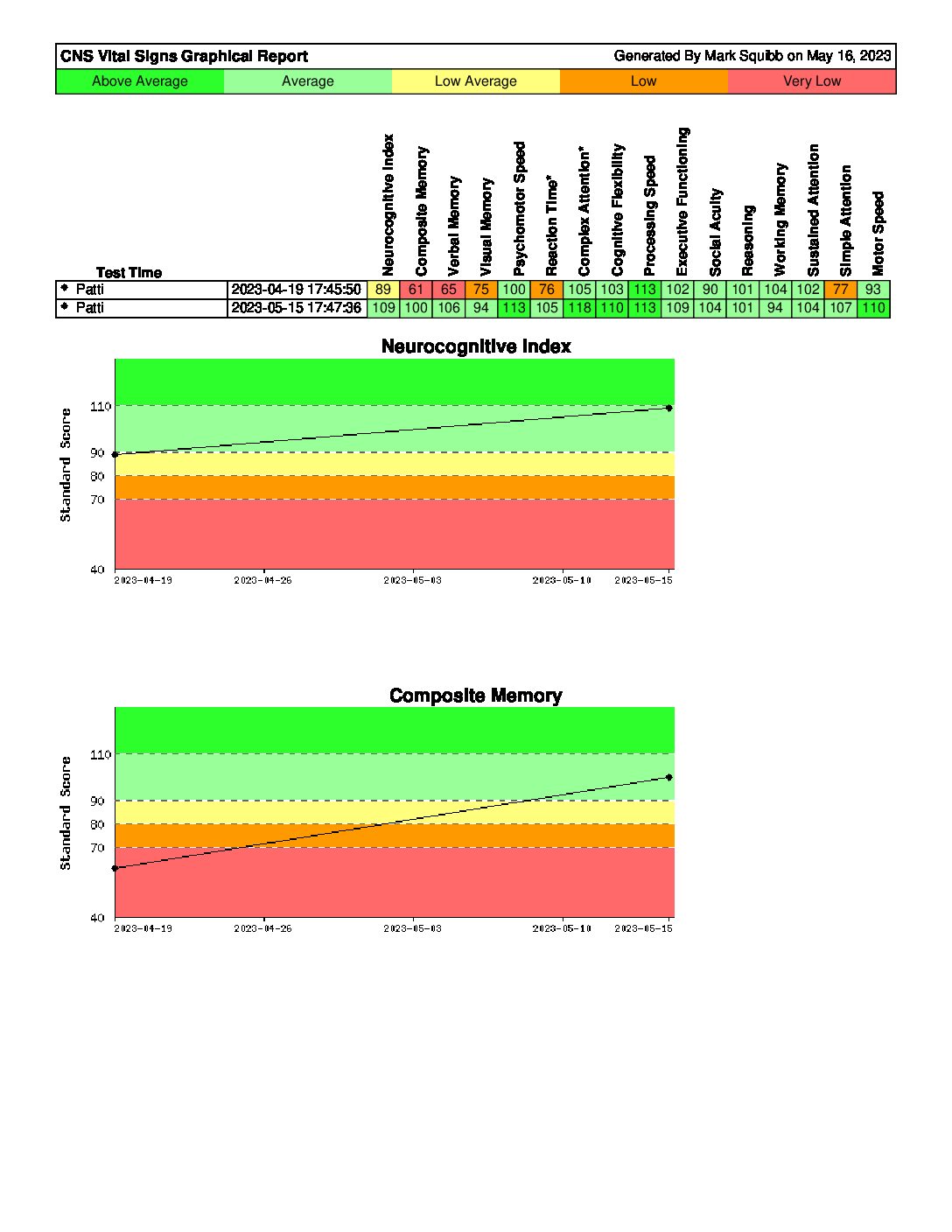
The green bars show the “after” scores. The improvement is visible across every measured domain. This is not a marginal gain in one area. It is broad-spectrum cognitive restoration — memory, attention, reaction time all moving significantly in the right direction.
Why This Matters for You
This case study proves one thing above everything else: concussed brain tissue can recover after being dormant for a very long time.
41 years. That is not a minor concussion from last month. That is damage from the Nixon administration still affecting someone’s brain function well into their late 50s. And it was fixable.
If you have ever had a concussion — even a mild one, even decades ago — there is a reasonable chance you are operating below your actual cognitive potential. Not because you are getting older. Because damaged tissue never got the oxygen it needed to heal.
The BrainO2 protocol, combined with proper conditioning, can deliver that oxygen. Not by putting you in a pressurized tube. By using your own body’s survival mechanisms to force maximum blood flow to the brain, then flooding it with oxygen at the exact moment when delivery capacity is highest.
There is hope to heal from injury a long time ago. The data says so.
Common Questions
41 years. The subject was injured in a car collision at age 17 and completed the BrainO2 protocol at age 58. The neurological improvements demonstrate that concussed brain tissue can recover even decades after injury.
20 days of athletic conditioning with the LiveO2 Extreme system, followed by a single session of the BrainO2 protocol. The conditioning phase is essential — it rebuilds baseline cardiovascular capacity and prepares the body for the intense BrainO2 session.
Using the CNSVS (Central Nervous System Vital Signs) clinical neurological testing system — the same standardized assessment used by medical professionals for concussion evaluation. Before and after scores were compared across multiple cognitive domains.
BrainO2 is an advanced protocol. You need a LiveO2 Extreme or Adaptive Contrast system, proper training, and ideally guidance from an experienced coach. Start with the BrainO2 digital course or protocol coaching before attempting it on your own.
The LiveO2 Extreme system was used for both the conditioning phase and the BrainO2 protocol session. The Extreme’s progressive hypoxia feature makes it easier to activate brain blood flow at moderate exertion levels.