
A Blood Survey, Taken During the Flu
In 2014 Mark Squibb had the flu, a microscope, and his own blood. He filmed the samples before and after training.
Mark Presents the Slides
The full presentation, with the microscope footage and the energy charts.
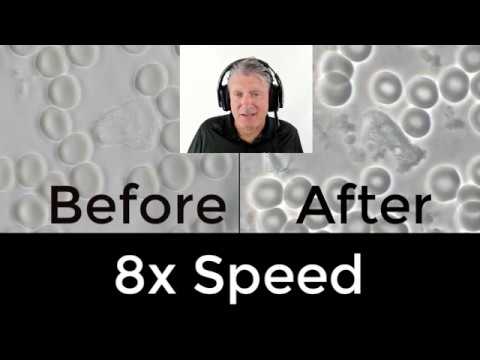
Mark Squibb founded LiveO2. In this presentation he walks through blood samples he took from himself in 2014, while ill. The samples were taken before and after training.
Why He Ran It
By 2014 Mark Squibb had been developing LiveO2 for two years. He wanted a way to show what was happening that did not depend on charts.
He had a microscope. He could draw his own blood and look at it. So when he caught the flu, he filmed the samples.
“Back in 2014 I did this experiment, which I think very clearly illustrated what was going on physiologically.”
— Mark Squibb, founder, LiveO2What follows is his record of his own blood, taken at intervals over about a week.
The Energy Curve
Mark opens with a chart comparing two versions of the same illness.
In an ordinary bout of flu, he describes energy dropping to less than half. Coming back to normal took eighteen to twenty-one days.
His own curve ran differently. He describes stepping off the system with energy above his normal baseline. It rose further over the following days as his immune system engaged.
“When I stepped off this system I felt almost fine. I mean, I knew I was still sick.”
— Mark SquibbThree days, against three weeks. Mark recovered faster than the rest of his family, who were not training.
“The last episode of the flu, it took everybody in the family three weeks to recover. What I did in three days.”
— Mark SquibbThe Slides, Before and After
The first pair of clips shows two white blood cells, one filmed before a session and one after. Mark sped the footage up roughly eight times.
The cell filmed after the session moves noticeably faster. He reads that as having more energy available to work with.
The second observation is about how the red cells sat together. Before training they stacked into a formation he names on screen.
“My blood cells liked to clump together into a formation called rouleaux, which means that they’re in a low energy state and they don’t have the electrostatic charge to repel each other very well.”
— Mark SquibbAfter the session the cells were more separated.
The Plasma Between the Cells
The change Mark found most striking was not in the cells at all. It was in the space between them.
Before training, he describes the plasma as basically clean. After the workout, the same space carried visible debris.
“That’s when I began to realize that [LiveO2] was very effective at helping you detoxify debris and other things that were trapped in the tissue.”
— Mark SquibbHis reading is that circulating blood hard through open capillaries washes out what is otherwise trapped in tissue.
Over the Following Week
Mark kept sampling. Three hours after the first session he describes the blood as looking dramatically better. The red cells showed a healthy glow.
The next morning the separation held, and he counted more white cells than the day before. A day later a pair of lymphocytes looked less active, so he trained again and reported feeling better afterwards.
Seven days in, the count was the thing that surprised him most.
“Seven days later I took another sample, and when I did I was stunned. What I saw was so many white blood cells I couldn’t believe it.”
— Mark SquibbThe published figures had led him to expect a modest rise. His own slides showed far more. His conclusion: training with oxygen while infected spins the immune system up, and the extra energy he measured was going into running it.
The Swimmers Analogy
Mark explains the mechanism he settled on in plain terms.
Think of white blood cells as swimmers. A swimmer in an oxygen-rich pool has more to draw on. It can do more work.
“That’s when I learned that when I’m sick, I want to have the highest possible oxygen level all the time.”
— Mark SquibbHe notes the results looked stronger than what he had read in Manfred von Ardenne’s work on multi-step oxygen therapy. That is where the underlying idea comes from.
Why He Published It When He Did
Mark released this presentation in March 2020, in the first weeks of the COVID-19 pandemic.
He frames it as something he wanted people to have while they were shut in at home.
“I’m publishing this on the eve of what appears to be a national, if not worldwide, health crisis. From my point of view, at least for my family, I’m not afraid. I have the tools.”
— Mark SquibbHe closes by urging viewers to get the best tool they can, and to look after the people around them.
Questions About What You Saw?
One person, one microscope, one week. Ask a trainer what the training actually involves.
Ask a trainerOr call 970-658-2789 and ask for a trainer.
Common Questions
No. It is one person recording his own blood over about a week while ill. There was no comparison group and no blinding.
It is the name for red blood cells stacking together like coins. Mark points it out in his before samples and describes the cells as more separated afterwards.
Mark reads it as material washing out of tissue once circulation opens up. The slides show material after a session that was not visible before.
He describes recovering in three days. The rest of his family took about three weeks, and were not training.
One. Mark sampled his own blood. His family members were not training and were not set up as a controlled comparison group.
This is a single person’s record of his own samples on one occasion. Individual results vary and are not guaranteed.
Mark references Manfred von Ardenne’s work on multi-step oxygen therapy, which is published separately and not affiliated with LiveO2.
A note on this page: the samples and observations described are Mark Squibb’s own, recorded from himself on one occasion in 2014. They are a personal record, not a clinical study. LiveO2 is not intended to diagnose, treat, cure, or prevent influenza, COVID-19, or any other condition, and nothing on this page is medical advice. Individual results vary and are not guaranteed. If you are unwell, please speak with your doctor.