
Why Oxygen Alone Is Not Enough
Breathing extra oxygen helps. But your body hits a ceiling. Here’s what actually breaks through it.
Mark Squibb Explains the Oxygen Ceiling
Why altitude contrast — not just oxygen — is the key to real delivery.
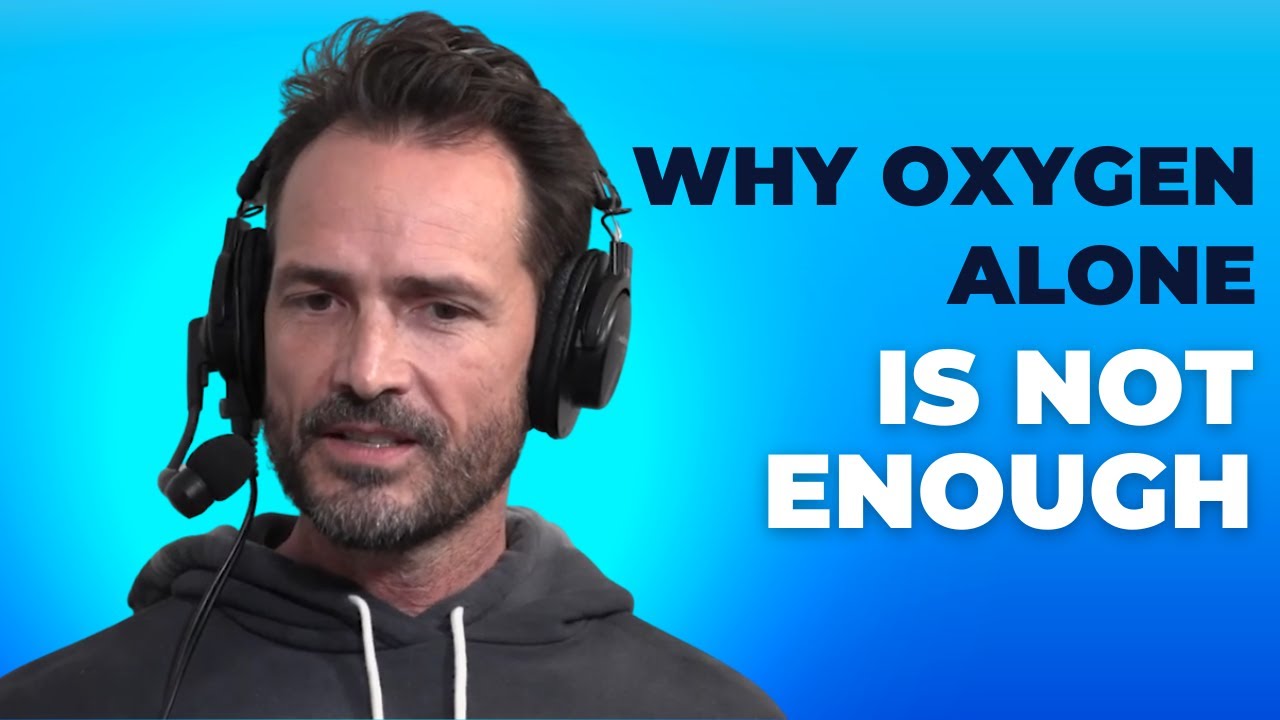
Most people assume more oxygen is the answer. Just breathe it in and your body will use it. Mark discovered that’s only half the story.
The Problem With Oxygen Alone
Your lungs already saturate your blood with oxygen. At sea level, hemoglobin runs at about 97% saturation. Breathing extra oxygen bumps that to 99–100%.
That’s a 2–3% gain. Not nothing. But not much.
The real problem isn’t getting oxygen into your blood. It’s getting oxygen out of your blood and into your tissues. Especially the tissues that need it most — your brain, your damaged muscles, your inflamed joints.
“With the straight oxygen, what happened was that I never could get my heart rate up to much over 150. So I couldn’t activate my vascular system. And I certainly couldn’t get activated enough that I could activate that circuit of blood flow through the brain.”
— Mark Squibb, LiveO2 InventorMark found the ceiling firsthand. Extra oxygen made his blood slightly richer. But it didn’t open the tiny capillaries. It didn’t drive his heart rate high enough to push blood into his brain. The oxygen stayed in his arteries. It never reached the places that mattered.
Why Your Body Has an Oxygen Ceiling
Your body is built for survival. It doesn’t waste resources. When you breathe extra oxygen, your body says: “We have enough. No need to work harder.”
Your heart rate stays moderate. Your blood vessels don’t dilate. Your capillaries — the tiny vessels that deliver oxygen to individual cells — stay partially closed.
Research confirms this. A 2020 study in Frontiers in Physiology found that hyperoxia during exercise counteracts the normal cardiovascular response — the body dials down its effort when oxygen is abundant.
More oxygen in. Less delivery out. That’s the paradox.
Standard EWOT — exercise with oxygen therapy — hits the same wall. You put on a mask. You breathe high-oxygen air. You pedal. You feel a little better. But you can’t force the oxygen past the bottleneck.
What Actually Breaks Through
Altitude training. Specifically, the contrast between low oxygen and high oxygen.
When you breathe low-oxygen air — simulating 10,000 to 22,000 feet of altitude — your body goes into emergency mode. Heart rate spikes. Blood vessels dilate. Every capillary opens to grab whatever oxygen it can find.
Then you switch to high oxygen. And all those newly opened pathways get flooded.
“I modified it to include the switch — to go from hypoxic to hyperoxic — so I could simulate that environment. And that’s when we really began to see the real power of the Adaptive concept. Doing the Adaptive process was creating two or three times the level of result. And in minutes.”
— Mark Squibb, LiveO2 InventorThis is called Adaptive Contrast. Low oxygen creates the demand. High oxygen fills it. Exercise drives the delivery system. Together, they break the ceiling that oxygen alone can’t touch.
A 2017 study in Alzheimer’s & Dementia found that intermittent hypoxic-hyperoxic training improved exercise tolerance and cognitive function in ways that standard approaches could not match.
Oxygen Alone vs. Adaptive Contrast
| Oxygen Alone (Standard EWOT) | Adaptive Contrast (LiveO2) | |
|---|---|---|
| Blood Saturation | 97% → 99–100% | Full saturation + open capillary delivery |
| Heart Rate | Moderate — body compensates | Elevated — hypoxic challenge drives it |
| Capillary Opening | Partial — no trigger to open more | Full — hypoxia forces capillaries open |
| Tissue Delivery | Limited by vascular resistance | Flood into open pathways |
| Brain Oxygenation | Marginal increase | Up to 24x more oxygen to the brain |
| Session Time | 15–30 minutes | 15 minutes |
What Mark Saw at 10,000 Feet
Mark was skiing in the Rocky Mountains. At altitude, his heart was pounding so hard he could hear it in his head. His body was doing everything it could to get oxygen to his brain.
He realized: that response — the heart pounding, the vessels dilating, the capillaries opening — that was the key. Not the oxygen itself. The body’s reaction to needing oxygen.
What if you could trigger that response on demand? And then flood the open pathways with oxygen?
He built a system that does exactly that. You breathe low oxygen for 1–3 minutes while exercising. Your body opens every pathway it has. Then you switch to high oxygen. The result:
“Two to three times the level of result. And in minutes.”
Oxygen alone asks your body to accept a gift. Adaptive Contrast makes your body reach for it.
Common Questions
No. Exercising with oxygen is still better than exercising without it. But you’re leaving results on the table. Standard EWOT bumps blood saturation by 2–3%. Adaptive Contrast opens the delivery system so that oxygen actually reaches your tissues.
You breathe air with less oxygen — the same as being at 10,000 to 22,000 feet. This triggers your body’s survival response: faster heart rate, wider blood vessels, open capillaries. Then you switch to high oxygen to flood those open pathways.
15 minutes. You alternate between low and high oxygen while pedaling a stationary bike. The contrast does the heavy lifting — you don’t need to exercise hard.
Yes. It’s the same oxygen level you’d breathe hiking at altitude. You breathe it for 1–3 minutes at a time, then switch back to high oxygen. Your body handles it the same way it handles a mountain trail.
During Adaptive Contrast, the hypoxic phase opens capillaries in the brain that normally stay closed. When you switch to high oxygen, the delivery volume to the brain increases dramatically. Users have measured up to 24 times the normal resting brain oxygen level using near-infrared spectroscopy.
No. More time doesn’t break the ceiling. The problem isn’t how long you breathe oxygen — it’s that your capillaries aren’t open to receive it. Only the hypoxic challenge opens them. See why contrast makes the difference.
Oxygen therapy is passive — you sit and breathe. Oxygen training combines oxygen with exercise and contrast to actively open your vascular system. The exercise is what makes the delivery work. Learn the difference.