
Oxygen Therapy vs Oxygen Training
One is done TO you. The other is done BY you. That difference changes everything.
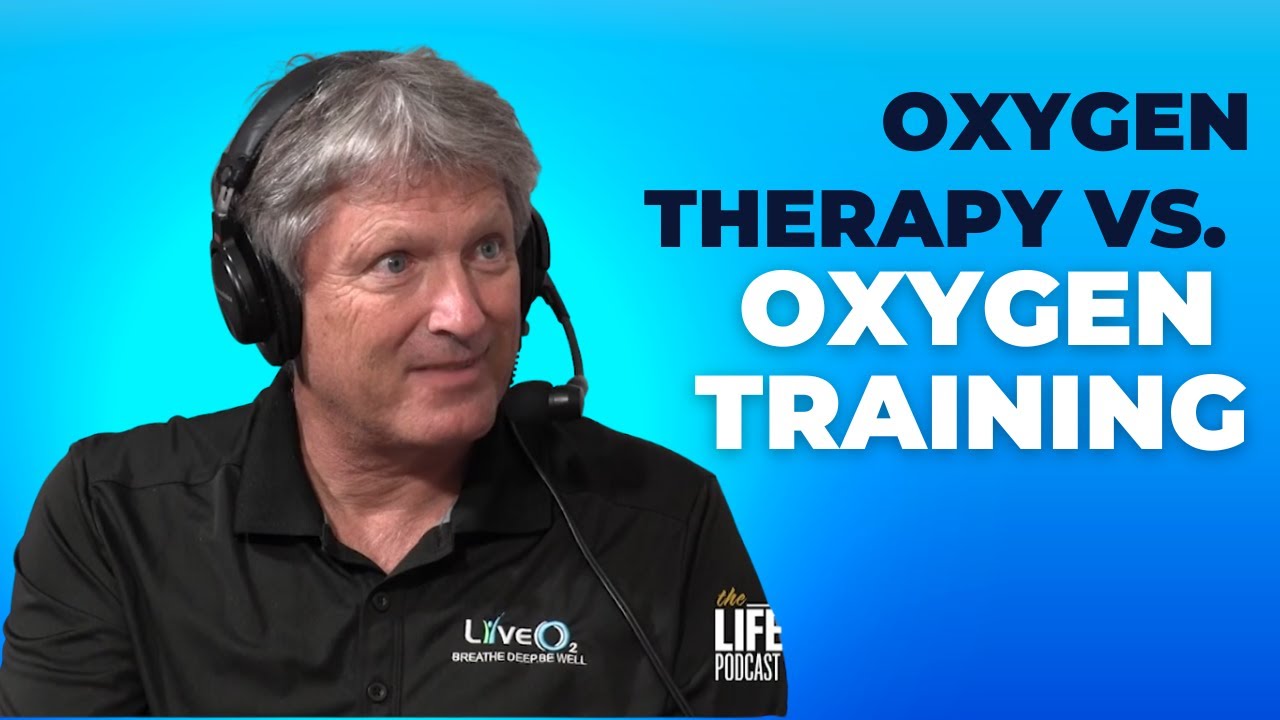
Watch Mark Break It Down
Mark Squibb, LiveO2’s inventor, explains why exercise changes how your body uses oxygen.
Most people think oxygen is oxygen. Breathe more of it, feel better. But how your body receives that oxygen matters more than how much you breathe.
The Problem with Passive Oxygen
Oxygen therapy means you sit or lie down while a machine delivers oxygen to you. You don’t move. You don’t exercise. You just breathe.
It works — a little. Your blood oxygen goes up. Some of that oxygen reaches your tissues. But here’s the problem:
Your body isn’t pushing it anywhere.
Without exercise, your heart rate stays low. Your blood pressure stays flat. Your capillaries — the tiny blood vessels that deliver oxygen to your cells — stay partially closed. The oxygen gets into your lungs. It gets into your blood. But it doesn’t reach the tissues that need it most.
Research confirms this. A 2019 review in the Journal of Physiology found that exercise increases oxygen delivery to skeletal muscle by up to 20-fold compared to resting conditions [1]. Passive breathing simply cannot match that.
What Oxygen Training Does Differently
Oxygen training means you exercise while you breathe enriched oxygen. That sounds like a small change. It’s not.
When you exercise, three things happen that passive therapy can’t do:
1. Your heart rate goes up. More blood pumps through your body every second. More oxygen gets carried to more places.
2. Your capillaries open. Exercise forces open the smallest blood vessels in your body. These are the vessels that feed your brain, your muscles, your organs. At rest, most of them are partially closed.
3. Your body adapts. This is the big one. When you train with oxygen, your body learns to use oxygen more efficiently. Your vascular system gets stronger. Your mitochondria multiply. You don’t just feel better for an hour — you build capacity that lasts.
Therapy keeps you dependent on the machine. Training makes your body stronger without it.
Side by Side
| Oxygen Training | Oxygen Therapy | |
|---|---|---|
| Your Role | Active — you exercise during the session | Passive — you sit or lie down |
| Heart Rate | Elevated — drives oxygen deep into tissues | Resting — limited circulation |
| Capillary Opening | Exercise forces capillaries open | Most capillaries stay partially closed |
| Oxygen Reach | Reaches brain, muscles, organs, extremities | Mostly lungs and major blood vessels |
| Lasting Effect | Builds vascular capacity over time | Benefits fade when you stop |
| Session Time | 15 minutes | 60–90 minutes typical |
| Dependence | Your body gets stronger — less dependence over time | You need repeated sessions to maintain benefits |
Why Exercise Changes the Equation
Your body has roughly 60,000 miles of blood vessels. At rest, a huge percentage of them are barely open. They don’t need to be. Your body is conserving energy.
When you exercise, your body sends a signal: open everything up. Blood flow increases. Capillaries dilate. Oxygen floods into tissues that were barely getting any.
A study in Experimental Physiology demonstrated that exercise combined with supplemental oxygen significantly enhances tissue oxygenation compared to supplemental oxygen at rest [2]. The combination works because exercise creates the demand and oxygen fills the supply.
Without exercise, you’re trying to push oxygen through a system that isn’t asking for it. It’s like running a garden hose with the nozzle half-closed. The water is there. But it’s not going anywhere useful.
Exercise opens the nozzle all the way.
Then Adaptive Contrast Takes It Further
Standard oxygen training is already better than passive therapy. But LiveO2 adds another layer: Adaptive Contrast.
Instead of just breathing high oxygen while you exercise, the system briefly switches you to low oxygen. Your body reacts like it’s at high altitude. Heart rate climbs. Blood vessels dilate even further. Every capillary in your body opens up.
Then you switch back to high oxygen. And all those newly opened pathways get flooded.
It’s the difference between filling a bucket and filling a fire hose. Same oxygen. Completely different delivery.
Who Is Each Approach For?
Passive oxygen therapy has its place. If you’re recovering from surgery and can’t move, it helps. If you have a medical condition that requires supplemental oxygen, your doctor prescribes it for a reason.
But if your goal is to get stronger — to improve energy, sharpen your brain, boost your endurance, recover faster, or slow aging — passive therapy won’t get you there.
Oxygen training is for people who want results that last. You don’t need to be an athlete. A light pedal on a stationary bike is enough. The point isn’t to crush a workout. The point is to get your body moving so the oxygen can do its job.
Fifteen minutes. That’s it. And you’re building something that stays with you after the session ends.
Common Questions
No. Oxygen therapy is a real medical treatment and it helps people who need it. But it’s passive. If you can exercise, adding movement to oxygen delivery produces significantly better results than sitting still.
No. Light exercise is enough. Walking on a treadmill or pedaling an exercise bike at an easy pace gets your heart rate up and your capillaries open. The oxygen and the contrast do the heavy lifting, not you.
Fifteen minutes. Most passive oxygen therapy sessions run 60 to 90 minutes. With LiveO2, you get deeper oxygen delivery in a fraction of the time because exercise multiplies the effect.
Yes. LiveO2 is designed for home use. You connect it to any stationary bike, treadmill, or elliptical. No clinic visits, no appointments. See how the system works.
If you truly cannot move, passive oxygen therapy is better than nothing. But most people can do more than they think. Even slow pedaling while seated counts. Any movement opens capillaries and improves oxygen delivery.
Because you’re not just delivering oxygen — you’re training your vascular system. Exercise with oxygen encourages new capillary growth, improves mitochondrial function, and strengthens your body’s ability to use oxygen on its own. Passive therapy doesn’t trigger these adaptations.
References
- Joyner MJ, Casey DP. Regulation of increased blood flow (hyperemia) to muscles during exercise: a hierarchy of competing physiological needs. Physiol Rev. 2015;95(2):549-601. PubMed
- Richardson RS, et al. Human skeletal muscle intracellular oxygenation: the impact of ambient oxygen availability. J Physiol. 2006;571(Pt 2):415-424. PubMed