
The Questions Every Practitioner Is Actually Thinking
Dr. Stephanie Youngblood sits down with LiveO2 inventor Mark Squibb to find out whether this belongs in her practice — and she asks what everyone else is afraid to.
Dr. Youngblood & Mark Squibb: The Full Conversation
A physician evaluates LiveO2 from the ground up — patient outcomes, practice fit, daily operations, and business model.
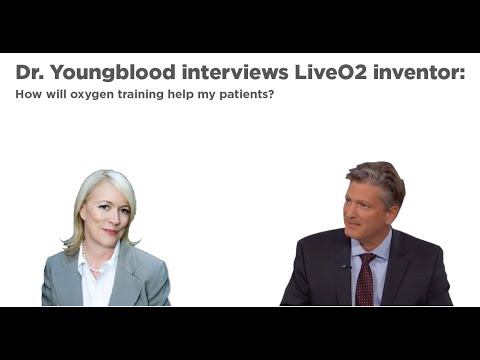
Dr. Youngblood came in with four specific questions. Most practitioners have the same ones. This conversation answers all of them — straight from the inventor.
How Will LiveO2 Help My Patients?
Most patients who seek out functional or integrative care have one thing in common: their cells aren’t getting enough oxygen to do their job.
That sounds simple. But it’s behind a long list of complaints: fatigue that sleep doesn’t fix, brain fog, slow recovery, chronic pain, and systemic inflammation that doesn’t respond to standard interventions.
LiveO2 Adaptive Contrast targets this directly. The protocol alternates between reduced-oxygen and high-concentration oxygen air during 15–20 minutes of light exercise. This cycling creates a cellular stress signal that triggers the body to:
- Build new mitochondria (the energy-producing structures in every cell)
- Reopen capillaries that have closed off over time
- Reduce systemic inflammatory load at the tissue level
- Improve oxygen delivery to the brain, muscles, and organs
Patients feel the difference quickly. Energy improvements often appear within 2–4 weeks of consistent sessions. A systematic review of intermittent hypoxia–hyperoxia training reported improvements in peak oxygen uptake and exercise tolerance across the studies reviewed (PubMed: 35639211).
The patients most likely to respond: chronic fatigue, post-COVID recovery, TBI and concussion history, age-related decline, athletic performance plateau, and anyone with systemic inflammation that hasn’t resolved with other approaches.
The protocol works at low exertion. Patients don’t need to be athletic. A moderate walking pace on a stationary bike is enough to drive the oxygen cycling effect.
How Will LiveO2 Improve My Practice?
Oxygen training is the piece most integrative and functional practices are missing — and it’s the piece patients increasingly ask about.
Adding LiveO2 to a clinic does a few things for the practice itself:
It differentiates you. Patients who are serious about optimization research what they want before they choose a provider. A clinic offering Adaptive Contrast oxygen training stands out from one offering standard EWOT or passive oxygen therapy. The protocol has a patent, a 15+ year research track record, and a growing community of practitioners and users who refer others.
It complements what you already do. LiveO2 stacks naturally with other modalities. It amplifies the effect of functional medicine protocols by improving cellular uptake. It works alongside red light therapy, PEMF, IV nutrient therapy, and cold exposure — each addressing a different cellular pathway. Oxygen is the input everything else depends on.
It creates patient loyalty. This isn’t a one-visit modality. People who experience results come back. Weekly sessions over months. They bring spouses. They refer friends. The protocol becomes part of their routine, not just a single appointment.
“Patients come in for one thing and end up staying for the oxygen. It becomes the anchor of the whole treatment relationship.”
— Practitioner feedback reported by LiveO2Is It Practical for Me to Use?
This is the question that kills most equipment purchases in a clinical setting. Great results in theory. Impossible to operationalize in a real practice.
LiveO2 is different. Here’s what running it day-to-day actually looks like:
Session length: 15–20 minutes. That fits into almost any appointment structure. Patients can arrive, complete a session, and be done before a standard consultation would end.
Footprint: small. The system consists of a stationary exercise bike, an oxygen reservoir bag, and a mask. It fits in a treatment room corner. No plumbing. No installation. No special ventilation requirements.
Staff time: minimal. After a brief orientation session, most patients self-administer the protocol. A staff member doesn’t need to be present for every session. Patients learn their settings and come in independently.
No consumables. There are no filters to replace, no chemicals, no recurring supplies to order. The system runs on standard medical-grade oxygen, which can be generated on-site or sourced locally.
Maintenance: low. The equipment is built for long-term use. There are no moving parts that need regular servicing. LiveO2 provides support and training to ensure the system stays operational.
Does It Make Money?
This is the question practitioners ask quietly. It’s also the right question to ask.
The economics are straightforward. LiveO2 is a one-time equipment investment. No ongoing license fees. No per-session costs beyond the oxygen supply. Once the system is paid off, sessions run at high margin.
Session fees. Practitioners typically charge per session or in package bundles. Because patients return consistently — often weekly for months — the revenue is recurring rather than transactional. A patient who comes in 3 times per week for 6 months is a fundamentally different revenue relationship than a patient who comes in for one consultation.
Protocol packaging. LiveO2 has a library of condition-specific protocols: Age O₂ for longevity, Brain O₂ for cognitive performance, Fatigue O₂ for energy restoration. These can be sold as defined programs with clear outcomes, which makes them easier to explain and easier to sell than open-ended treatment plans.
Referral effect. People who get results tell other people. Especially in the biohacker, longevity, and functional medicine communities — where word travels fast and personal recommendations carry significant weight. Practices that offer LiveO2 often report that it becomes one of their most word-of-mouth-referred services.
The return on investment depends on session volume and pricing. But the structure is clear: one-time equipment cost, no recurring fees, recurring patient revenue, and a differentiated service that attracts the type of patient most practices want more of.
Common Questions from Practitioners
Functional medicine, integrative medicine, naturopathic, chiropractic, physical therapy, and longevity-focused concierge practices are the most natural fits. Sports performance facilities and wellness centers offering biohacking services also adopt it frequently. The common thread is a patient base that is already health-literate and willing to invest in prevention and optimization.
The system fits in a standard treatment room or a small dedicated area. You need space for a stationary exercise bike and the oxygen reservoir bag. Most practices set up a dedicated room and run patients back-to-back through scheduled session blocks. There is no plumbing, installation, or ventilation requirement.
LiveO2 provides onboarding training for practitioners and staff. The system is designed to be straightforward to operate. After an initial setup session, most patients can self-administer with minimal staff involvement. LiveO2 also has an online training portal and ongoing support for clinical questions.
Most patients report feeling noticeably more alert and energized immediately after the session. Some describe a mild warmth or tingling as circulation improves. Occasionally, patients experience a detox response in the first few sessions — mild fatigue or headache — which typically resolves quickly. Energy and clarity improvements tend to accumulate over repeated sessions.
Standard EWOT (Exercise With Oxygen Therapy) delivers high-concentration oxygen during exercise. LiveO2 Adaptive Contrast adds a hypoxic (reduced-oxygen) phase that standard EWOT lacks. This cycling between oxygen-reduced and oxygen-rich air is what activates the cellular stress response that drives mitochondrial biogenesis and deep tissue oxygenation. The hypoxic phase is what makes the hyperoxic phase dramatically more effective. See: Adaptive Contrast vs Standard EWOT.
Yes — and it works better when combined. Oxygen is the input that every other cellular protocol depends on. Red light therapy, PEMF, IV nutrient therapy, and cold exposure all work at the mitochondrial or vascular level. LiveO2 improves oxygen delivery to the tissue, which amplifies the effect of anything else you’re doing. Most practitioners who add LiveO2 report that their existing protocols start producing better results.