
Two Knee Replacements. One Stunned Surgeon.
Elizabeth Jones works in neurological care. Eight weeks after her second knee replacement, her surgeon checked her surgery date three times.
Hear Her Story
Her knee recovery, her own training, and what her patients report — in her own words.
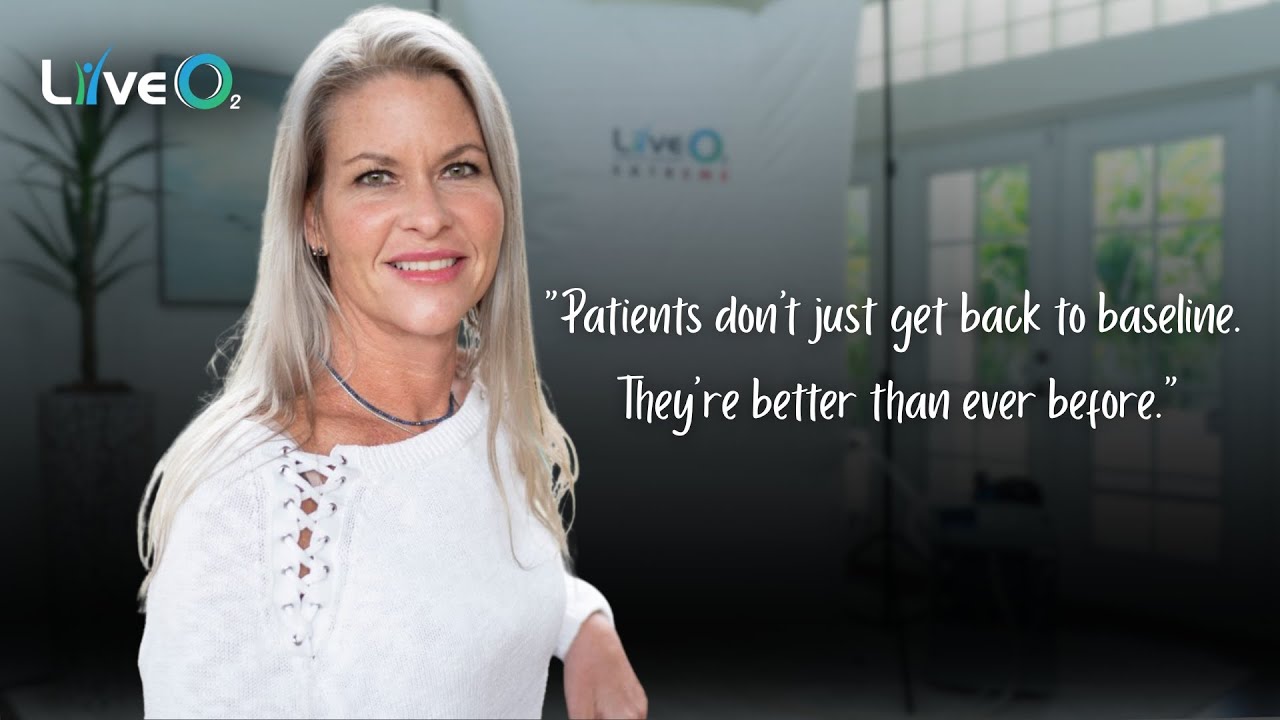
Elizabeth Jones led neurological diagnostics and therapeutic services at Hope Neurological and Medical Services. Her clinic has used LiveO2 since the early days. She thought she knew what it could do. Then she trained one-on-one with the LiveO2 team — and used it on her own knees.
Four ACLs. Then Two Knee Replacements.
Elizabeth is an athlete. She works out six days a week.
Her knees have paid for it. Four ACL surgeries. Then a knee replacement.
A year later, she was back on the table. Same surgeon. A second replacement.
“I’ve been through a lot of knee surgery. So I had to have a knee replacement. I apparently created space in that, so I had to go back and get another one a year later.”
— Elizabeth Jones, Hope Neurological and Medical ServicesThis time she did one thing differently. She started LiveO2 sessions very soon after surgery.
“I started doing it very quickly after my surgery, because I was like, this one is going to be great.”
— Elizabeth Jones“Check That Date Again”
Eight weeks after the second surgery, she went back for her checkup.
Her surgeon had done both surgeries. He knew what eight weeks should look like.
This did not look like eight weeks. He had his assistant check the surgery date. Three times.
“He was like, no, there’s no way you are that healed. Because I was like, why does it still hurt when I run? … He was like, I wouldn’t be surprised if you’re still using a walker right now.”
— Elizabeth JonesHe expected a walker. She was asking about running.
“You should have seen his face. ‘No, no, no. Check it again. Check that date again. There’s no way she’s healed this far.’ And I’m asking why it hurts to run.”
— Elizabeth Jones, eight weeks after surgery
She also credits the mobility she got back. Her words: “It’s remarkable, the difference.”
Why might oxygen matter after surgery? Healing tissue needs oxygen to rebuild. LiveO2 switches you between low-oxygen and high-oxygen air while you exercise. The low phase opens blood vessels. The high phase sends oxygen-rich blood through them. In healthy adults, this kind of training shifted markers of inflammation and oxidative stress (PubMed: 34502508). The researchers suggested it for people whose injuries keep them from training hard.
Running Uphill. Kickboxing.
The knees healed. She kept going.
Today she runs. She runs uphill. She took up kickboxing.
“I’ve had four ACLs, two new in the same leg, and I’m still working out so I can run. I even now run uphill. I started doing kickboxing. It rewinds your physical clock, if that makes sense.”
— Elizabeth JonesHer back changed too. She had a herniated disc. For years, she got an epidural injection every three months.
After about nine months of regular LiveO2 training, she told us she hadn’t needed one since.
“Your body’s a chain. I had a herniated disc, so I used to get epidural injections every three months. And that was for years. I’ve been actively doing it for the last nine months. I haven’t had one since.”
— Elizabeth JonesElizabeth’s experience is her own. Individual results vary. Talk to your doctor about your own recovery plan.
What Else Changed for Her
The knees are the headline. But she noticed more.
- No inhaler before workoutsBad bronchitis left her using an inhaler before every workout. Now she doesn’t. “I found myself at my normal pace. Why? And I would get on an incline, and then more of an incline.”
- Her legs tire before her lungs“It used to be where you just can’t keep going. That’s absolutely not the case.”
- A 20-minute session that feels like 90“I can go through four to five desaturation rounds in about 20 minutes and feel like I was working out for an hour and a half.”
- A clear head on hard days“If I have a day when I’m stressed and I can’t think straight … that is what I do, and it’s smooth sailing for the rest of the day.”
- People notice“I will come into work sometimes and people are like, what have you been doing? Your skin looks great.”
Her body also adapted. Over time it took her longer to drop her oxygen during a session. She now adds short breath holds to keep it challenging.
What Her Patients Report
Elizabeth’s clinic is a neurology practice. Most patients come in after car accidents or with concussion symptoms. Ages run across the board.
She asked her whole team to report back on every patient they had put on LiveO2. She asked for the negatives too.
Her answer: “Crickets.”
- Headaches, often within one session“Imagine having a headache that just won’t stop, and going from a ten to a three in 20 minutes.”
- Concussion patients who feel better than before“Not only do they feel better, they feel better than even before the concussion.”
- “My brain just woke up”“They take the mask off and they’re like, whoa, I feel like my brain literally just woke up.”
- Calmer, steadier“I have many people that said it’s helped with their anxiety.” Patients also tell her they sleep well.
- A measurable shiftHer team runs a standard cognitive assessment. Testing herself and staff before and right after a session, she reports “at least 15% difference.”
“Literally, our patients are like, ‘Why isn’t this everywhere? How can I get one at home?’ … Or, ‘Can I keep coming?’”
— Elizabeth JonesHer staff use it too. Some now bring workout clothes to work. When they feel run down or stressed, they get on the bike.
Patient results are as reported by Elizabeth. Individual results vary.
How She Explains It to Patients
Elizabeth has two pictures she uses.
The muddy sponge. Your body holds on to years of buildup. A LiveO2 session wrings it out.
The pinched hose. Breathing extra oxygen at rest only goes so far. Inflammation narrows the path, like a kink in a hose. The low-oxygen phase opens it up so the oxygen can get through.
“It’s not an injection here or a surgery just on this body part. It’s whole body.”
— Elizabeth JonesThat’s why she says plain oxygen breathing and LiveO2 “can’t compare.” It is also why sessions are short. A review of low-then-high oxygen training found gains in oxygen uptake and exercise tolerance (PubMed: 35639211).
From Two Cities to Twelve
When her clinic first got LiveO2, there were two protocols. Today there are more than 30.
Elizabeth felt they weren’t using it to its full potential. So she called LiveO2 and trained one-on-one with Annette, a LiveO2 trainer, for months.
What she got was the “why,” not just the “how.” How to adapt a session for a concussion, a knee injury, or an athlete. What to do when a pulse oximeter shows something odd. How to explain it to a patient in plain words.
“You can know the how, but you have to know the why behind it. … When I’m explaining, I’m not just repeating what someone else said to me.”
— Elizabeth JonesHer practice has since grown from Atlanta and South Carolina to 12 cities across the U.S. Her goal is a LiveO2 department of its own.
“If I could just spread it around everywhere, because it’s so beneficial to everyone.”
— Elizabeth Jones
Common Questions
Elizabeth started soon after her second knee replacement. Sessions use light exercise, often on a recumbent bike, and an arm bike works when legs can’t. Check with your surgeon before you start, and build intensity as you heal.
At her eight-week checkup, her surgeon had her surgery date checked three times. He said he expected she might still be on a walker. She was asking why her knee still hurt when she ran. Individual results vary.
No. Elizabeth’s clinic uses it with patients of all ages, many recovering from accidents. She tells them to imagine power walking in the mall — just slightly breathless. Athletes can push much harder. How hard do you need to exercise?
Most sessions take about 20 minutes. Elizabeth fits four to five low-oxygen rounds into that time and says it feels like a 90-minute workout.
Plain oxygen raises the oxygen in your blood, but narrowed blood vessels can still block delivery. LiveO2 adds a low-oxygen phase that opens vessels up, then switches to high oxygen. Elizabeth calls plain oxygen a “pinched-off hose.” Learn how Adaptive Contrast works.
Yes. Elizabeth trained one-on-one with a LiveO2 trainer for months. She learned how to adapt sessions for concussions, injuries, and athletes, and how to explain the science to patients.