
“Back to Faster Than I’ve Ever Been” — Dr. Drew Denson’s Return to Endurance Racing
A chiropractor and lifelong endurance athlete left running behind for six years. Eighteen months after coming back — training consistently and using LiveO2 — he reports beating the times he set in college.
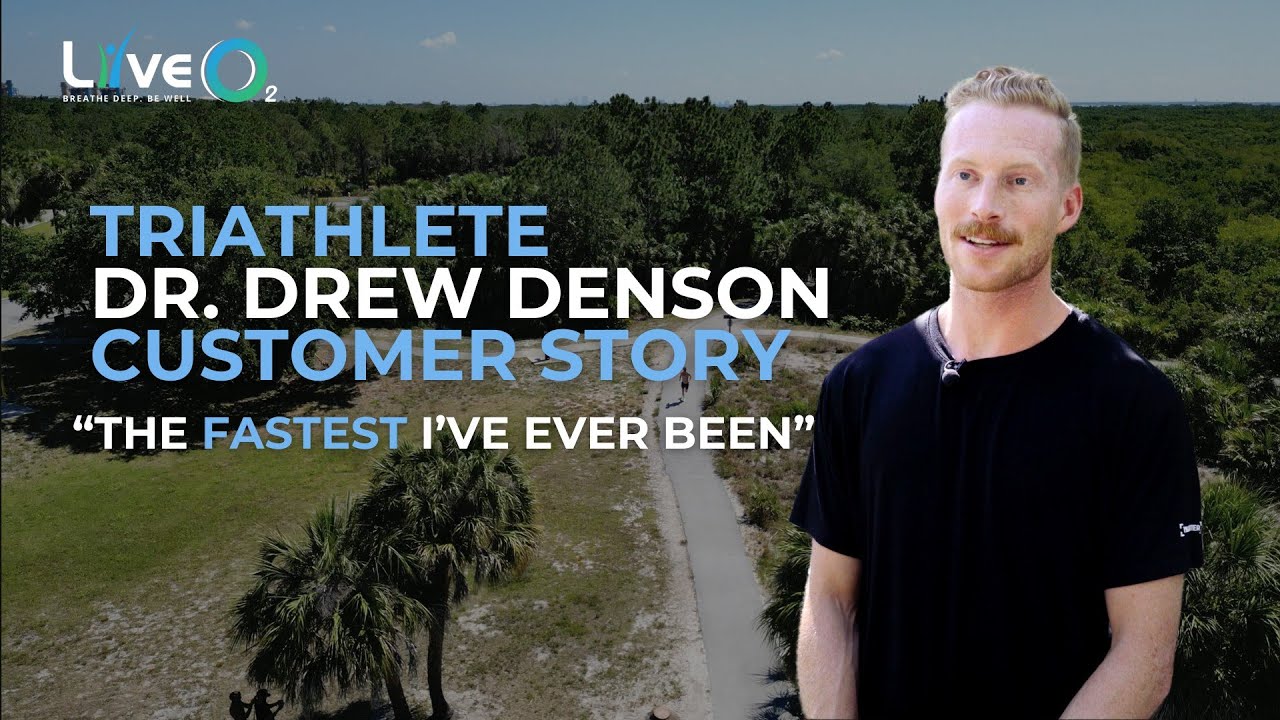
Dr. Drew Denson in his own words — 2 min 14 sec.
Who Dr. Drew Denson Is
Drew Denson is a chiropractor in St. Petersburg, Florida, and an endurance athlete — triathlon and distance running — for most of his life. He describes his current approach to the sport in terms that will sound familiar to anyone still competing into their thirties and forties: keep performing, find whatever edges are available, and keep enjoying it.
“I’m also an endurance athlete. I do triathlon and distance running — I’ve done that for most of my life and it’s been a passion of mine. And now, finding ways to continue the performance and find edges where I can, and also enjoy the process, have fun, and take a holistic approach to the whole training side of things.”
— Dr. Drew DensonThe Part Most Comeback Stories Leave Out: Six Years Completely Off
Denson didn’t taper down from competition. He stopped. What makes his account worth reading is that he is candid about how far gone the fitness was, and about the doubt that came with it.
“Coming out of college I was pretty burned out. I didn’t know if I’d ever run again, much less competitively.”
— Dr. Drew DensonThe gap that followed was not active recovery or cross-training toward a return. In his description, it was six years of yoga, surfing and skateboarding — and by his own account, not much running or aerobic exercise of any kind.
- CollegeCompetitive distance running. Sets the times that become the benchmark — then burns out.
- The six years afterYoga, surfing, skateboarding. In his words, “not much running or any aerobic exercise for that matter.”
- The returnConsistent training resumes, with LiveO2 Adaptive Contrast sessions as part of it.
- About 18 months inHe reports being back past his college times — “faster than I’ve ever been.”
What He Says Surprised Him
The detail Denson keeps returning to is not the result itself but the speed of it — how quickly the body responded after so long away.
“It took me years to run these times initially. And then I took six years off — just yoga, just surfing and skateboarding, not much running or any aerobic exercise for that matter. And then now, in about a year and a half of consistent training and doing LiveO2, I’m back to faster than I’ve ever been.”
— Dr. Drew DensonHe is explicit that this was not the expected outcome:
“I didn’t expect that. I blew my own mind to see how quickly the body could accommodate the training, the stressors, and allow me to perform at a level that I didn’t really see imaginable.”
— Dr. Drew DensonOn the protocol itself, his summary is short: “LiveO2 is by far the most unique training protocol I’ve ever experienced.” He attributes the difference to the timing — the alternation, rather than oxygen alone.
Why the Alternation Is the Point
Endurance athletes who plateau have usually optimised the obvious variables — volume, nutrition, sleep, coaching. The one rarely trained on purpose is how efficiently oxygen reaches working tissue. Speed and sustained output both depend on delivering oxygen to muscle faster than it is consumed, and clearing metabolic byproducts before they accumulate enough to limit performance.
Adaptive Contrast alternates oxygen-rich and oxygen-reduced breathing during exercise. The alternation is the active ingredient — it asks the oxygen transport system to respond to changing demand rather than hold one steady state. That is the “timing” Denson points to.
For an athlete rebuilding aerobic capacity from a long layoff, the relevant question is how quickly that system can be trained — which is precisely what Denson describes being surprised by.
You Set the Intensity — From Easy Spin to Full HIIT
This is the point most often misunderstood about oxygen training, in both directions. It is not a passive therapy you sit through, and it is not a session that demands you empty the tank. The effort is relative to you, and you decide where in the range you work.
| How hard you take it | What that looks like | Who tends to work here |
|---|---|---|
| Light | Easy pedal or walk — enough to lift heart rate above resting and move blood through opened capillaries. | First sessions, deconditioned starts, recovery days |
| Moderate | Steady aerobic effort you could sustain and hold a conversation through. | Most regular users, most training days |
| Hard | Sustained tempo effort — working, breathing heavily, still controlled. | Conditioned athletes building aerobic capacity |
| Full HIIT | Intervals at high output against the contrast cycle, taken to the limit of what you can repeat. | Competitive athletes chasing performance edges |
The floor is genuinely low. LiveO2’s inventor Mark Squibb puts it in absolute terms: if your resting heart rate is 72, anything that brings it to 80 is enough to produce a physiological response, because the oxygen contrast is doing the work that effort alone would otherwise have to do.
The ceiling is where athletes live. Nothing about the protocol caps how hard you can work — a competitive athlete can run intervals at full intensity against the contrast cycle and train oxygen delivery under genuine competitive load. Denson, a triathlete and distance runner, is working at the demanding end of that range, not the accessible one.
That range is why the same system fits a member returning to exercise and an athlete chasing a personal best. The protocol is identical. The effort you bring to it is not, and it should scale with your conditioning and your goal.
Where a 15-Minute Session Fits in a Training Week
The practical question for a competitive athlete is not whether to add something, but where it goes without disturbing what already works. A session is short enough to attach to an existing training day rather than replace one — and the intensity you bring should change depending on which day it is.
| Training day | Typical placement | Intensity to bring | Why |
|---|---|---|---|
| Easy / recovery day | Standalone session | Light to moderate | Keeps the day genuinely aerobic while still training oxygen delivery |
| Day after hard intervals | Morning session | Light | Where athletes most commonly report noticing recovery first |
| Dedicated capacity day | As the session itself | Hard to full HIIT | Intervals against the contrast cycle, under real competitive load |
| Key workout day | Not stacked before the workout | Light, if at all | Preserves the quality of the primary session |
| Race week / taper | Reduced frequency, keep it familiar | Light | Taper is not the week to introduce anything new or hard |
General placement guidance reflecting how athletes commonly schedule sessions — not a prescription. Programming and intensity should be set with your own coach.
What to Measure If You Want to Know Whether It’s Working
Denson’s benchmark was unusually clean: he had college race times to measure against. Most athletes won’t have a gap that stark, so the useful approach is to record a baseline and hold other variables steady early on.
The cleanest signal. Same course, same perceived effort — watch whether the clock moves.
How quickly heart rate drops in the 60–120 seconds after a hard interval.
Whether you arrive at the next hard day genuinely ready, rather than carrying the last one.
Whether the last interval of a set holds closer to the first than it used to.
Denson also credits the “consistency that I’ve been able to maintain” alongside the performance gains themselves — a reminder that showing up repeatedly matters as much as how hard any single session goes.
For Coaches and Training Facilities
Denson’s account is one athlete’s experience. What makes it relevant to a coach or facility operator is its shape: a short session, added to an existing programme, measured against times the athlete already had on record.
- It doesn’t compete with training time. A session runs about 15 minutes.
- One system covers your whole floor. The intensity is set by the individual, so the same equipment serves a deconditioned member at an easy pedal and a competitive athlete running full HIIT intervals against the contrast cycle. You are not buying for one segment.
- It fits an existing floor. The system needs room for a stationary bike and the reservoir — a corner, not a build-out.
- Returning athletes are a natural fit. Denson’s case is a comeback from a long layoff, not a marginal gain at the elite edge.
- No clinician required to run sessions. Trained fitness staff operate the protocol; coaches can programme intensity the way they would any other conditioning tool.
Frequently Asked Questions
Dr. Denson is a chiropractor; his comments describe his own experience as an athlete and are not medical advice or a clinical opinion. His account reflects one individual’s experience during a period of training with LiveO2 and is not a prediction of anyone else’s results. Individual responses vary. LiveO2 is not intended to diagnose, treat, cure, or prevent any disease. Consult your own physician before beginning any new training protocol.