
A Father Son Recovery Story
Retired Navy captain Brian Frazier, in his own words
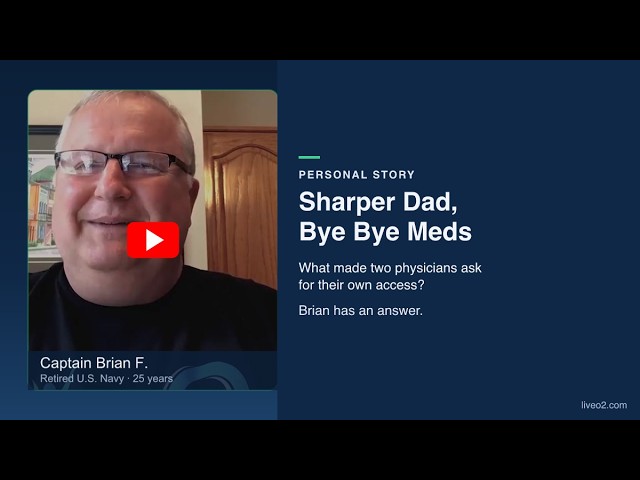
Brian tells the story in his own words.
What Brian reports
He wasn’t looking for himself
Brian Frazier spent twenty-five years in the United States Navy, retiring as a captain. When he started researching oxygen training, he wasn’t looking for anything for himself. He was looking for his father.
In the 1970s, his father sustained a traumatic brain injury. Among the lasting effects, Brian says, was the loss of his sense of taste and smell — something that had been gone for more than forty years. More recently, the family had begun noticing changes in his short-term memory, and that was the thing that pushed Brian to start looking for options.
He describes going through the usual channels first. A brain center in Atlanta ran their workup. Hyperbaric oxygen came up as a possibility, but the cost and the time commitment made it impractical for his family.
Then he found LiveO2 — and, by his own account, spent more than a year not believing it.
What LiveO2 Adaptive Contrast is
Most oxygen approaches are passive. In a hyperbaric chamber, you lie still while pressure does the work. Standard oxygen training is a step up — you exercise while breathing oxygen-rich air — but the oxygen level stays constant the whole time.
Adaptive Contrast is different: the air itself changes during your session. You alternate between oxygen-rich air and thinner, higher-altitude air while doing light exercise. That back-and-forth is the “contrast,” and it’s the part that makes the training active rather than passive.
The reason it matters is circulation. Exercise opens up blood flow. Thinner air prompts the body to respond the way it does at altitude. Then the switch to oxygen-rich air arrives while circulation is already wide open — so oxygen-rich blood is carried deep into tissue, including the brain, rather than simply sitting in the lungs.
Practically, it’s a reservoir bag, a mask, and hoses, used with whatever exercise equipment you already have — a bike, a rebounder, a treadmill. Brian describes the setup as taking minutes: hang the bag, connect the hoses. He and his father tried it the same day they put it together.
Sessions are short and don’t require medical supervision. Fifteen to thirty minutes is typical. Brian describes his own as roughly fifteen minutes at a heart rate in the 130–140 range — real effort, but nothing extreme.
What Brian says he watched happen
What follows is Brian’s account of his own family’s experience, in his words.
“The doc said, hey, you’re done, just go home. Physical therapy would be a waste of time and money for you now — you’re completely healed up.”— Brian, describing what his father’s orthopedic surgeon told him after a calf injury
Brian also describes changes in his father that he did not anticipate. After more than forty years without it, he says his father’s sense of taste returned — and mentions carrot cake specifically, the way people do when a small ordinary pleasure comes back. He describes his father, now eighty-one, going from ten pull-ups to thirteen, and using the system daily.
“Some brain activity from something that happened forty years ago — you would think all that stuff in there was dead. But if you can get that oxygen back to it, it can come back and start working again.”— Brian, offering his own interpretation of what he observed
He reports changes in his own bloodwork too, after using the system two or three times a week.
“My blood sugar was high. Borderline type 2 diabetic — perfectly normal. Liver function perfect, kidneys perfect. I mean, just phenomenal.”— Brian, describing his own lab results as reported to him
And he describes his wife’s experience over about two months of use, following years of a recurring issue her doctors had been tracking.
“
It is too good — but it’s not too good to be true.
Captain Brian F., on how he’d describe it to a skeptic
From skeptic to operator
The part of Brian’s story that says the most about where he landed isn’t a health claim at all — it’s what he did next.
He describes neighbors who are physicians trying the system and wanting their own access. Eventually he partnered with two of them, rented office space, and formed an LLC so other people in his area could use it.
A man who spent over a year deciding whether to believe it now runs a location.
“If you want results, this delivers.”
Common questions
Should I stop treatment my doctor recommended to try this?
No. Never delay, decline, or stop care your physician has recommended. Oxygen training is exercise with supplemental oxygen — it is not a treatment for any condition, and it is not a substitute for medical care. Talk to your doctor before starting any new exercise program.
Is this a typical outcome?
No. This page is one family’s personal account. It is not typical, not predictable, and not a result LiveO2 claims or promises. Individual experiences vary widely, and many factors affect anyone’s health over time.
What is Adaptive Contrast?
Light exercise while the air you’re breathing alternates between oxygen-rich and thinner, higher-altitude air. Exercise opens circulation, the altitude air prompts an adaptive response, and the oxygen-rich air then reaches deep into tissue. The contrast is what makes it active training rather than passively breathing oxygen.
How long are the sessions in Brian’s household?
He describes roughly fifteen minutes at a moderate heart rate, a couple of times a week for himself. His father uses it more frequently. What’s appropriate for any individual should be discussed with their physician.