
Jill and Three Concussions
A Recovery Story
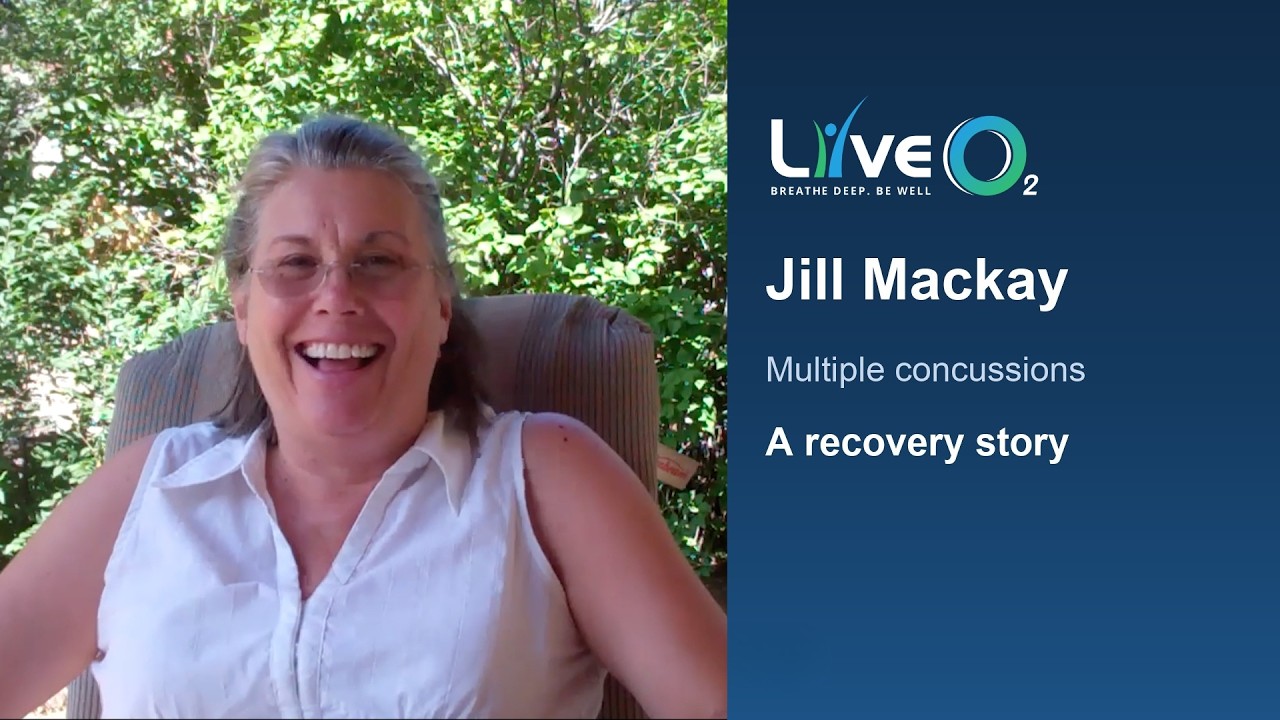
Jill tells her story in her own words.
Before the Training
My name is Jill Mackay. I’m 55 years old. Over about a year and a half I had three concussions — the first two were falls, and the last was a car accident in March 2013.
I’m an artist, a sculptor, and a product designer. My work is to imagine an idea, then draw it in 3D from every angle, with all the measurements, so a factory can build it.
“I had a brilliant mind that could envision things in three dimensions.”— Jill
After the concussions, that changed. I would rate my abilities now at about 22% of what they used to be. I couldn’t do my work. Just functioning in the world felt hard, and I was on medication for depression.
“It’s like being a new person that is far less capable, and I second-guess everything I do.”— Jill
In Her Own Words, After
Right after the session, Jill described feeling different — clear-headed and calm.
“I feel more alert. I feel more alive. Very relaxed, very alert. No anxiety. Calm, and very clear — surprisingly clear.”— Jill
She had exercised hard during the session, keeping her heart rate up. She said that normally would have left her dizzy and lying down with a severe headache.
“I have no headache.”— Jill
That weekend, she did three technical drawings in a row — the first design work she had been able to do since the concussions. She also ran again: tenth-of-a-mile intervals and some sprints, something she hadn’t done in a couple of years. No headache afterward.
“I know I’m getting better, because I couldn’t do it before.”— Jill
Neurological Results
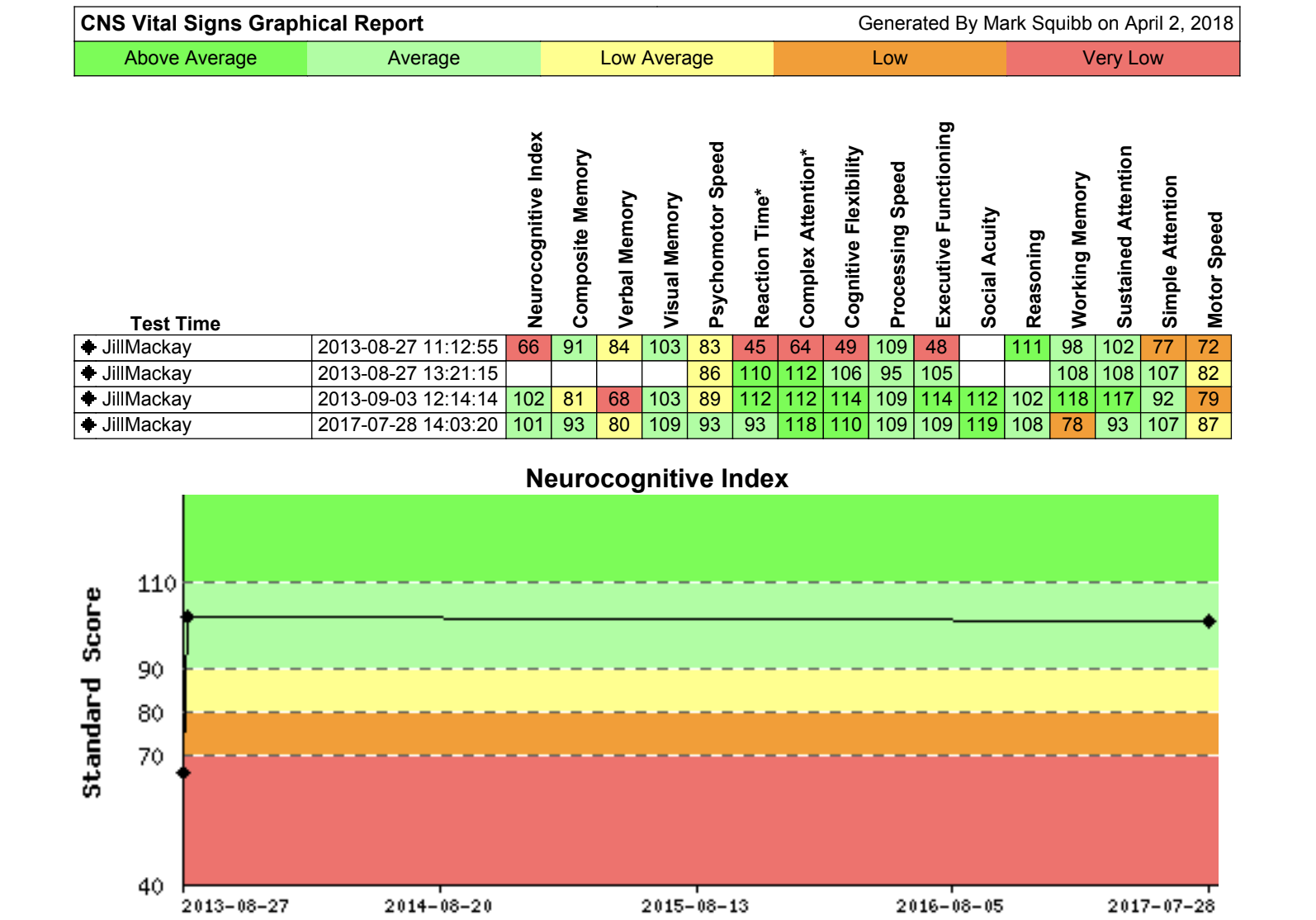
Jill’s cognition was measured with CNS Vital Signs — a computerized neurocognitive test that scores brain functions like memory, attention, and reaction time against a normal range, where 100 is average.
At her baseline on August 27, 2013, her Neurocognitive Index was recorded at 66 — in the “Very Low” range. One week later, on September 3, it was recorded at 102 — “Average.”
“I went from low, very low to average and above average — on nearly every one.”— Jill, on retaking the test the same day
How long did it last?
That is the real question with any recovery. Jill was tested again nearly four years later, on July 28, 2017 — and her Neurocognitive Index was still recorded at 101, in the “Average” range. Across the four years shown, her scores held there. It was a durable result, not a temporary lift.
later
Neurocognitive Index (standard score · 100 = average)
Very Low
Average
Average
About the Test: CNS Vital Signs
CNS Vital Signs is a computerized neurocognitive test battery used in clinics and research. It measures things like memory, processing speed, reaction time, and attention, and reports each as a standard score against a normal range — where 100 is average and higher is better.
In its validation study, the battery was given to more than 1,000 people between the ages of 7 and 90 to build its normal ranges, and its reliability was found comparable to established conventional and computerized tests. What any individual’s scores mean is for a licensed clinician to interpret; this page simply reports the numbers that were recorded.
Gualtieri CT, Johnson LG. “Reliability and validity of a computerized neurocognitive test battery, CNS Vital Signs.” Archives of Clinical Neuropsychology. 2006;21(7):623–643. Read the study on PubMed