
LiveO2 Reservoir Design: Why Materials, Seams, and Plastics Matter for Your Breathing Air
You’re breathing from this bag. Here’s exactly what it’s made of, why it’s built the way it is, and what LiveO2 spent 7 years getting right.
What the LiveO2 Reservoir Is Made From
When you exercise with supplemental oxygen, you breathe from a large fabric bag. That bag touches your air supply for every breath. So the material it’s made from matters a lot.
LiveO2 uses the thinnest possible layer of plastic for the inner liner. There are 2 reasons for that choice:
- Thin plastic holds fewer chemicals than thick plastic. Less material means less to offgas into your breathing air.
- Thin plastic lets trapped chemicals escape faster. The shorter the diffusion distance, the sooner the product “cleans” itself.
LiveO2 materials are tested and confirmed at less than 3 parts per million of volatile organic compounds (VOCs). That’s a very low number.
The seams are sewn — not heat-welded. Non-airtight sewn seams let any remaining chemicals escape instead of trapping them inside with your oxygen supply.
Fill Time and Overflow — Two Problems, One Solution
Every gas reservoir has to solve 2 problems:
- Fill time — how long does it take to fill the reservoir before you can start?
- Overflow tolerance — what happens when the oxygen concentrator keeps running after the bag is full?
LiveO2 reservoirs do not release oxygen until they are full. Tests show no meaningful difference in fill time between sealed and open designs.
The overflow problem is solved with a network of tiny holes built into the reservoir fabric. When the bag is pressurized, these holes open and let excess oxygen escape. No relief valve. No extra parts. No build-up of pressure that could turn the reservoir into something that needs special safety storage rules.
A gas-tight zipper is also included. It lets you drain the bag quickly, inspect the interior for cleanliness, and prevents gas from being trapped in the air compartment.
The whole design goal: use as little plastic as possible. Fewer parts. Simpler build. Cleaner air.
Why LiveO2 Stopped Using Welded (Sealed) Reservoirs
LiveO2 tried sealed, heat-welded reservoirs for years. Every attempt hit the same wall of problems. Here is what was discovered:
- All gas-impermeable materials require thick plastic. Thick plastic holds more chemicals and takes longer to release them. Even “food grade” or “medical grade” thick plastic could not be made odor-free.
- A sealed reservoir traps chemicals permanently. The chemicals cannot escape. The user inhales them over the entire life of the product. This is the opposite of what a breathing system should do.
- Sealed reservoirs pressurize. Pressure requires a relief valve. A relief valve only opens once the reservoir is already over-pressurized — a worse outcome than simply letting gas escape through fabric holes.
- Pressurized oxygen storage triggers regulations. A pressurized oxygen container must be colored green, properly labeled, and stored according to compressed gas rules. That creates a complicated ownership experience.
- Pressurized delivery to a user = breathing assistance. That classification invites medical device regulation — a different category from wellness equipment.
LiveO2 avoids all 5 of these problems by not sealing the reservoir.


How the LiveO2 Reservoir Is Actually Built
After 7 years of development and several design iterations, the current reservoir design integrates two key layers:
- Woven nylon protective outer shell — lightweight but highly resistant to rips and puncture. This is the layer you see and handle.
- Non-VOC inner liner — the thin-film layer that holds oxygen. This is the layer your breathing gas contacts.
For Adaptive Contrast systems, the reservoir also integrates both the oxygen chamber and the low-oxygen (high-altitude simulation) chamber into the same bag. This removes the need for a separate altitude reservoir, extra hoses, and additional setup steps.
The result is a simpler setup with fewer connections, fewer parts to fail, and a smaller footprint during a workout.
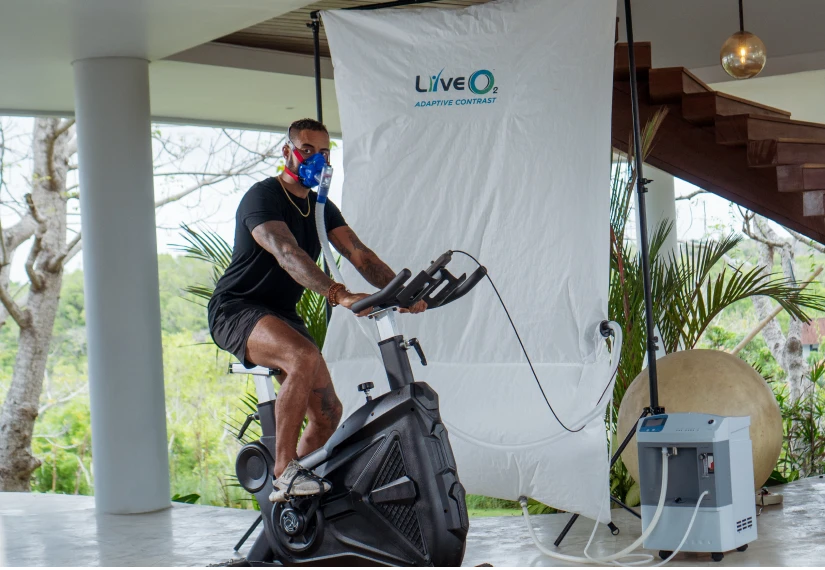
Why Is the Reservoir White?
Early LiveO2 reservoirs were dark-colored and tightly sealed. That design had a hidden flaw.
In rare cases — usually due to user error or storage in very humid environments — moist air could back-flow into the reservoir. Once inside, moisture could cause mold. Dark material made mold invisible until it was a real problem.
The switch to white solves this in one step: any contamination is immediately visible. That change, combined with a zipper-based inspection and drainage port, makes hygiene checks practical instead of theoretical.
The zipper port enables 4 things that a sealed dark reservoir cannot:

What Happens Inside Every Piece of Plastic
All plastic starts as a liquid cocktail of chemicals. Those chemicals link together to form the solid plastic — a process called curing. But the chemicals that drove the reaction don’t vanish. They stay dissolved inside the plastic, the same way water stays in a sponge.
These trapped chemicals are called Volatile Organic Compounds, or VOCs. They are in every plastic product — food containers, medical devices, bags, tubing. Over time, they slowly escape through the surface of the plastic.
For most products this is not a big concern. But for a breathing system that holds 900 liters of gas, with roughly 70 square feet of plastic surface area in contact with your breathing supply, it matters a lot. Two factors determine how much risk exists:
- How much VOC is trapped at the start — determined by plastic thickness. Thicker plastic = more total VOC load.
- How fast VOCs escape — also determined by thickness. Thin plastic = short escape path = faster clean-out.
This is why LiveO2 uses the thinnest possible liner. Less plastic in the first place. Faster off-gassing before the product ships. Lower VOC exposure for the user from day one.
Good Plastics and Bad Plastics — Why PVC Has No Place in a Breathing System
Not all plastics are the same. There are 2 main categories relevant to breathing systems:
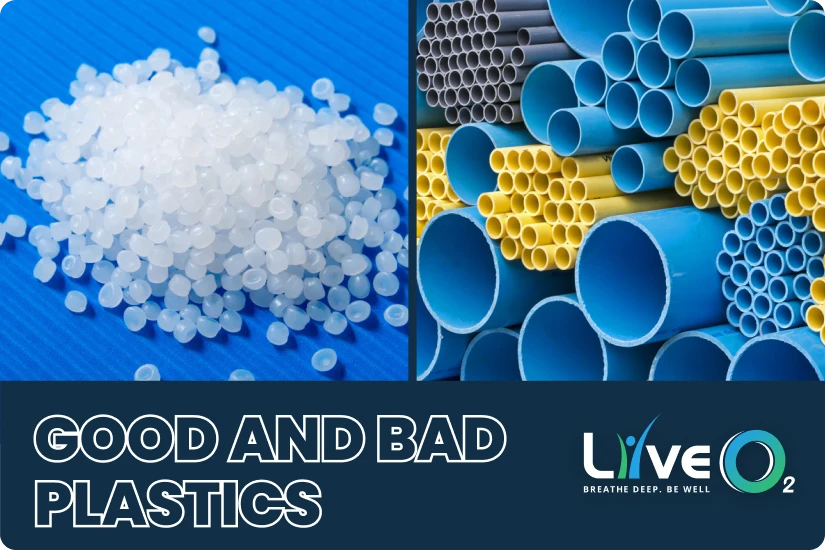
Polyethylene (PE) — the plastic used in food and medical applications. Its VOCs are not recognized toxins. This is what LiveO2 uses for the reservoir liner.
Polyvinyl chloride (PVC) — a different story entirely. PVC is known to release toxic gases. It should never be used in any breathing system under any circumstances.
Important: Any breathing system that uses clear plastic tubing uses PVC. Clear plastic in a breathing circuit is a warning sign. LiveO2 uses only biologically inert silicone tubing — never PVC.
The rule is simple: if you can see through the tube or bag, it is likely PVC. Silicone tubing is slightly cloudy or opaque. LiveO2 uses silicone for all tubing and a polyethylene-based liner for the reservoir — no PVC anywhere in the breathing path.

The Roll Effect and the Bag Effect — Why Bag Size and Sealing Are a Bigger Deal Than You Think
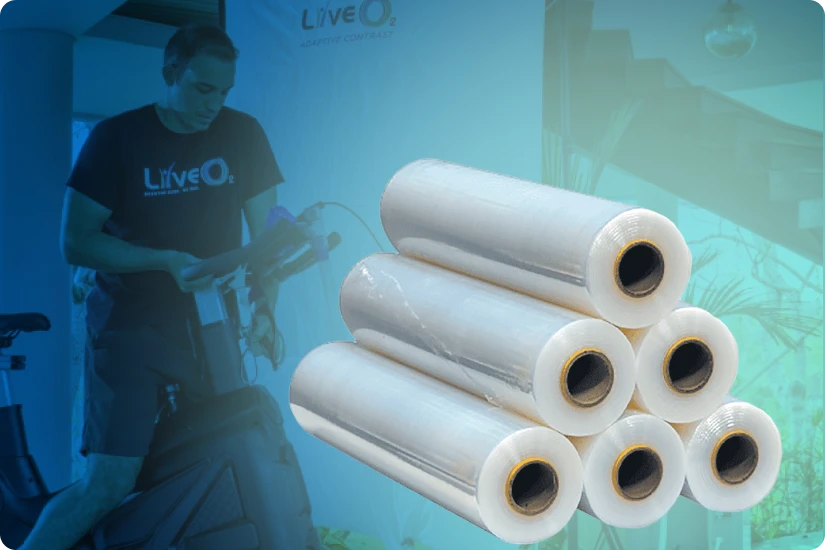
Pull a trash bag out of the box and smell inside the box. That smell is VOCs trapped in the rolled-up plastic. The thick roll, with many layers pressed together, holds the chemicals in almost indefinitely.
Now take a single bag and lay it flat for a week. Smell the outside — the odor is mostly gone. Smell the inside — much worse. The chemicals escaped in both directions, but outside they dispersed into the air. Inside they accumulated in a closed space.
A 900-liter oxygen reservoir is a very large bag. The math compounds fast:
- Larger bag = more square feet of plastic surface
- More surface area = more total VOC load
- Sealed bag = VOCs cannot escape, they accumulate inside
- User breathes from the inside of the bag for every session
This is why LiveO2 spent years finding materials with the smallest possible plastic content — and why not sealing the bag is not a compromise, it is the safest design choice for a breathing product of this size.
Frequently Asked Questions
White material makes hygiene inspection practical. Any moisture buildup, discoloration, or contamination inside the reservoir is immediately visible against white fabric. Early dark-colored reservoirs could hide problems until they became serious. The white design, combined with a zipper inspection port, lets users confirm the interior is clean before and after each session.